
Check the risks before considering an offshore casino
A practical look at legality, payments, bonuses, game verification and the limits of what reviews can establish.
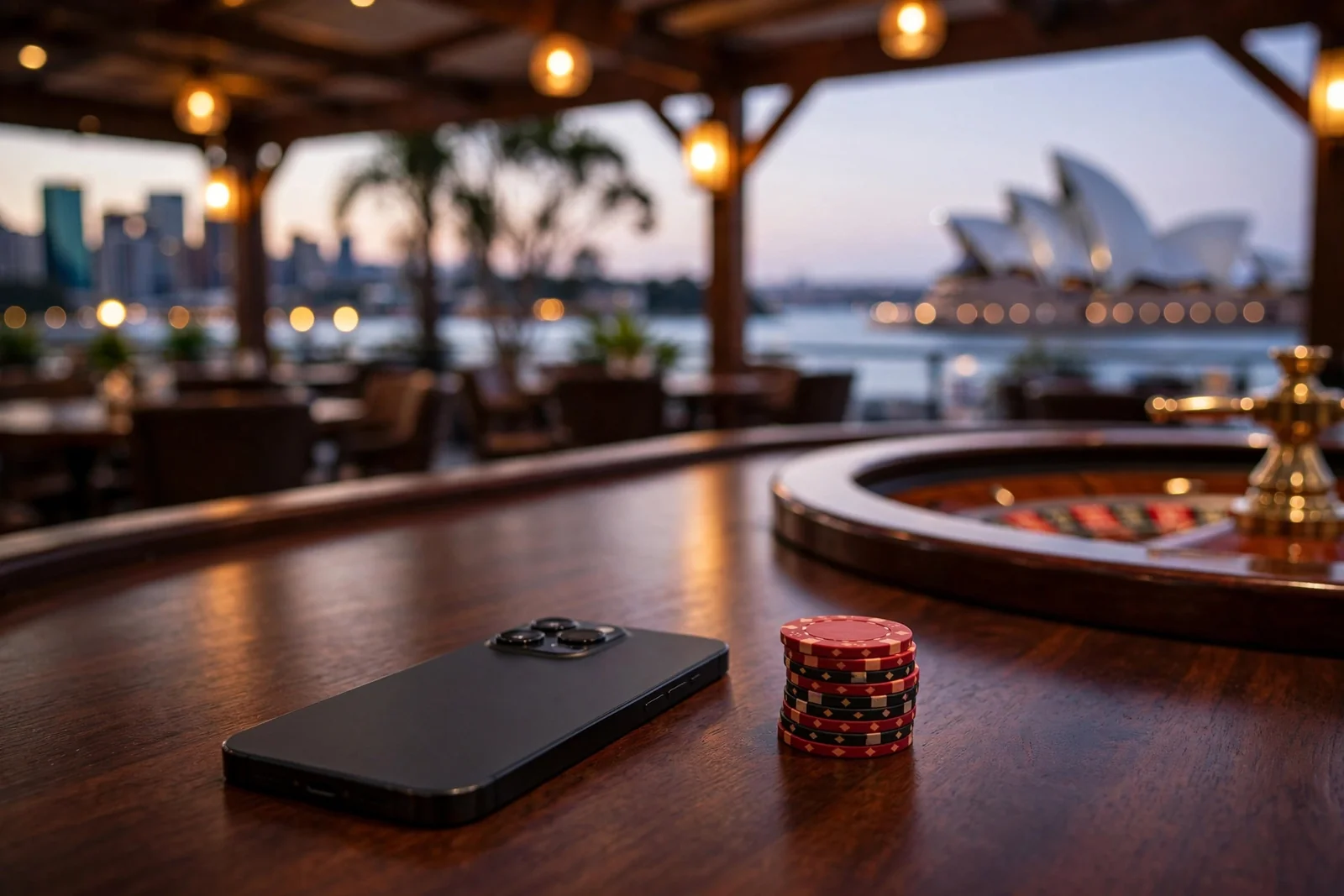
What “international casino” means for Australian players
When Australians describe an “international casino”, they generally mean an operator based outside Australia that accepts, or appears to accept, customers here. The label describes where the business is situated; it does not change where you are when you use its service. If you are physically in Australia, Australian law remains relevant, even when the operator’s website, company or licence is overseas.
That distinction is easy to miss. A foreign address or licence can make a site look distant from Australian rules, but it does not give the operator permission to offer online casino-style gambling to people in Australia. Under the Interactive Gambling Act 2001, operators are prohibited from providing those services to users located here. The restriction is directed at the provider, not framed as a ban on an individual punter playing at an offshore mobile casino. That does not turn the service into a locally authorised or protected option.
I used to treat “international” as if it meant broader choice and fewer complications. It is really a location label. It tells you little, by itself, about who runs the site, what protections apply, or what happens if there is a dispute. An offshore crypto-friendly casino is still an offshore operator; the payment language does not alter its legal position in Australia.
Choosing an international casino means weighing the details that matter to you, such as licensing, deposit minimums and payment times. Use these entries as a concise reference when considering options for Australian players in 2026.
-
House of Pokies
- License
- international iGaming licence – jurisdiction not named in the source
- Payout speed
- PayID 1-24 hours
- Min. deposit
- A$30 (PayID from A$10)
House of Pokies lists an international iGaming licence, though the jurisdiction is not named in the available information. PayID payouts are stated as taking 1–24 hours, and the minimum deposit is A$30, or A$10 via PayID.
-
7Bit Casino
- License
- Curacao, operated by Dama N.V.
7Bit Casino is licensed in Curacao and operated by Dama N.V., details that identify its licensing jurisdiction and operator.
-
Rollero Casino
- License
- Curacao Gaming Control Board OGL/2023/176/0095 (Hollycorn N.V.)
Rollero Casino lists a Curacao Gaming Control Board licence, OGL/2023/176/0095, and is operated by Hollycorn N.V.
-
LevelUp Casino
- License
- Curacao eGaming OGL/2023/174/0082 (Dama N.V.)
- Min. deposit
- A$15
LevelUp Casino lists a Curacao eGaming licence, OGL/2023/174/0082, and is operated by Dama N.V. Its minimum deposit is A$15.
-
Golden Pokies
- License
- Curacao
Golden Pokies lists Curacao as its licensing jurisdiction.
-
WinSpirit Casino
- License
- Curacao eGaming OGL/2024/923/0383 (Antillephone N.V.)
- Min. deposit
- A$30
WinSpirit Casino lists a Curacao eGaming licence, OGL/2024/923/0383, issued to Antillephone N.V. Its minimum deposit is A$30.
-
Vegaz Casino
- License
- Curacao OGL/2024/1335/0780
- Min. deposit
- EUR 20
Vegaz Casino lists a Curacao licence, OGL/2024/1335/0780. Its minimum deposit is EUR 20.
-
Playfina Casino
- License
- Curacao eGaming (Hollycorn N.V., since 2017)
- Min. deposit
- A$20-30 (depends on the offer)
Playfina Casino lists a Curacao eGaming licence and identifies Hollycorn N.V. as its operator since 2017. Its minimum deposit is A$20–30, depending on the offer.
-
Uptown Pokies
- License
- Curacao (operating since 2017)
- Min. deposit
- A$20
Uptown Pokies lists a Curacao licence and has been operating since 2017. Its minimum deposit is A$20.
-
Wild Tokyo
- License
- Curacao
- Payout speed
- crypto 30-60 minutes, fiat 1-5 days
- Min. deposit
- A$10
Wild Tokyo lists a Curacao licence. Its stated payout times are 30–60 minutes for crypto and 1–5 days for fiat, with a minimum deposit of A$10.
A foreign licence is not Australian approval
Operators that accept Australians may point to licensing jurisdictions such as Curaçao, Malta, or Gibraltar. Those names refer to overseas regulatory settings, not Australian authorisation. A foreign licence may tell you which authority the operator says oversees it, but it does not override Australia’s rules on providing online casino services to people here. Nor should the presence of a licence be read as proof that an Australian regulator can resolve your complaint.
That gap matters in practical terms. If an offshore operator refuses to pay winnings, there is no Australian government body you can turn to as a dedicated complaints authority for that dispute. You may be dealing with a company and regulator outside the country, under processes that are not the same as local consumer protections. I would not treat a badge, a footer link, or a claim of international regulation as a safety net. It isn’t one.
The Australian Communications and Media Authority, or ACMA, works to restrict access to illegal gambling websites. A site loading for you today is not evidence that it is approved or will remain accessible; access can be blocked. Trying to get around a block with a VPN adds another risk: an operator may treat VPN use as a breach of its rules, close the account, or void winnings. I would not assume a connection workaround protects either access or funds.

The operator’s address does not move the player
The central point is where the service is being offered and where you are using it. A casino company may be incorporated overseas and host its website elsewhere, but that does not relocate an Australian customer. The law’s focus on the operator also does not mean the operator’s conduct has been endorsed just because a site accepts a registration from Australia.
For an individual, playing at an offshore casino is not itself illegal under the Interactive Gambling Act 2001. That distinction is worth stating plainly, without dressing it up as a recommendation. The legal restriction applies to operators providing the prohibited service to people in Australia. A punter’s lack of liability under that particular law does not guarantee that an offshore site is accessible, reliable, or able to offer the protections you might expect from an Australian service.
You must be at least 18 to register and gamble in Australia. Meeting that age requirement does not resolve the separate question of whether an operator may lawfully provide its service to someone located here. Nor does an operator’s willingness to accept a registration settle that question. “Available” and “authorised” are not the same thing.
Before putting money into any site, confirm that it accepts your location and read its own access rules. That check is not a workaround for Australian law, and it cannot make a prohibited service locally approved. If the site’s terms are unclear about Australian customers, that uncertainty is a reason to stop rather than guess. I learned that the hard way: a page that opens is not a promise of recourse.
So, in this context, “international” means offshore—not officially Australian, and not automatically safer or lawful for the operator to offer here. The distinction between the operator’s location and yours is the part worth keeping in view. A foreign licence, a working website, or a successful sign-up does not erase it.
Slots and casino games: what can be verified
A casino lobby can make a collection of games look like the main thing to compare: familiar categories, rows of colourful tiles and titles that sound ready to play. But for someone in Australia, the first question is not which game appears in that lobby. It is whether an operator is allowed to provide online casino-style games to people here.
Under the Interactive Gambling Act 2001, operators are prohibited from offering online casino-style games to users in Australia. That covers real-money casino games, including pokies and table games. An offshore site’s description of its catalogue does not change that boundary. Nor does a game being easy to find, carrying a familiar name or appearing alongside other products make its provision to people in Australia lawful.
I can’t vouch for any particular game title or current catalogue. More importantly, a list of titles would not answer the legal question. The relevant issue is the service being offered to people physically in Australia, not how a particular game is labelled or presented.

A game’s label is not the legal test
You may see a site describe its products as “international,” “global” or “available worldwide.” Those are marketing descriptions, not a ruling on Australian law. The same goes for labels such as pokies, casino games or entertainment. Changing the wording does not turn an online casino-style game into something outside the law if the service is still being offered as real-money gambling to people here.
I’ve learned to treat confident labels with a bit of distance. “Worldwide access” can sound like a green light; it is not one. A site’s own wording cannot settle whether its service complies with Australian law. And an overseas regulator or business address would not override the Australian restriction on operators providing online casino-style games to customers in this country.
That distinction matters when a site presents a large catalogue as proof of quality. A long menu may tell you how the operator wants to sell the experience. It cannot, by itself, establish that the operator may legally provide those games in Australia, that a specific title is available to Australian users, or that a claim about a game has been independently checked.
What a game listing can—and cannot—tell you
A game tile or title is a claim about what the site says it offers. It is not proof that the game will load for a user in Australia, that its description is accurate, or that the operator is authorised to provide it here. I would not treat a catalogue as an assurance of any of those things.
The same caution applies to broad claims about game variety. A site can describe a collection as extensive or up to date, but those phrases do not resolve the legal issue. They also do not tell you whether a particular title is available to someone in your location. It is safer to separate what a page claims from what that claim actually establishes.
This is not a technical distinction for its own sake. If you focus only on whether a title appears in a menu, you can miss the more important point: Australian law prohibits operators from offering online casino-style games to users in Australia. The presence of a game is not a permission slip.
Real-money games and virtual-credit apps are different
There is a separate category that can cause confusion. Social and free-play casino apps use virtual credits and are legal to use in Australia. Their availability does not mean that real-money online casino games are permitted. The key difference is the kind of service and whether the play involves gambling with money.
A virtual-credit app may use casino-style presentation, but that does not make it the same as a real-money casino service. Equally, calling a real-money service “social” or describing it as entertainment would not, on its own, change what it is offering. Look at the substance of the service rather than relying on a label.
That distinction is worth keeping clear if you are comparing what appears in an app store with what an offshore website advertises. One category does not establish the legality of the other. A familiar look or shared terminology is not enough to make them equivalent.

Don’t mistake popularity for permission
It is easy to assume that if a game or site is widely discussed, it must have been checked. I have made that kind of assumption before: visibility can feel like reassurance. It isn’t. A title being mentioned online, or a site displaying it prominently, does not demonstrate that the operator can provide it lawfully to people in Australia.
The same goes for claims that a game is popular with Australian users. Popularity is not a legal test. Neither is a game’s origin, its style, or the fact that it can be accessed from a device in Australia. The operator’s act of offering online casino-style games to users here is the central issue.
I would also be wary of treating a game description as an independent assessment. Words such as “trusted,” “fair” or “top” may sound like findings, but without a clear basis they remain claims. Even if a description accurately names a game, that still does not resolve whether its provision to Australian users is lawful.
Keep the question in the right order
If you are trying to understand casino games mentioned by offshore operators, start with the Australian legal boundary rather than the game menu. The Interactive Gambling Act 2001 prohibits operators from offering online casino-style games to users in Australia. That applies regardless of whether a site highlights pokies, table games or another casino-style category.
After that, keep claims in their proper place. A catalogue can show what an operator says it offers; it cannot establish legal permission in Australia. A game name can identify a title; it cannot prove that the title has been checked or that access to it is lawful. And virtual-credit apps should not be confused with real-money casino services.
I’m not going to dress an unverified title list up as a recommendation. The clearest thing to say is also the most useful: no individual game name changes the legal status of an operator’s offer. The boundary comes first.
Real-money play and the cost of getting money in and out
The payment screen can make offshore real-money gambling look like a simple transfer: choose a method, send funds, and expect them back if you win. That is not a safe assumption. The operator is providing a service that is illegal when offered to people in Australia, and a payment method working at the deposit stage does not guarantee that a withdrawal will be accepted or paid.
A specialist review describes PayID deposits as near-instant and typically free, but that is a report about a particular service, not a promise that every operator supports it or that every transfer will go through. Check the operator’s current cashier information and the terms for both deposits and withdrawals before sending money. The options shown may differ, and a method listed for depositing may not be available for cashing out.
One familiar option has also disappeared from the local payment picture: POLi ended its Australian operations in September 2023, so it no longer handles Australian transactions. If an offshore site still displays it, treat that as a reason to check the details carefully rather than assuming the button is usable.
Card payments can fail for reasons outside the casino’s own payment system. A specialist review reports that some Australian banks flag or block gambling-related card charges. A declined transaction therefore does not necessarily mean the card details are wrong; the bank may be stopping the payment. I would not keep retrying through different routes without understanding what is being authorised.

Getting money out can involve another hurdle: identity checks. For a first withdrawal, an operator may ask for KYC documents, such as identification or a selfie, as well as proof of address. That can delay a request, and submitting documents does not itself guarantee that the operator will release funds. Read the verification requirements before transferring anything, and consider what personal information you would be handing over.
Then check whether the cashier’s rules tie withdrawals to the original deposit method. Some operators require that, while others list certain options as deposit-only. If you choose a method that cannot receive withdrawals, you may have to use another route or resolve the issue with the operator. The rule should be clear before you pay in.
Keep a record of the payment method, transaction status, and any messages from the operator. If a deposit is debited but not credited, or a withdrawal is delayed, those details may help you describe the problem. Still, there is no Australian government body to complain to that can make an offshore casino pay winnings it refuses to release. That is the part a glossy cashier page leaves out.
A “no deposit” bonus still comes with strings
“No deposit” sounds like money with nothing attached. Read the terms and it can look different: the offer may not require an initial payment, but that does not mean you can withdraw any resulting balance freely. I treat the label as a headline, not a measure of value.
The first thing I look for is the wagering requirement. A specialist review describes welcome-bonus requirements in the range of 30x to 50x the bonus amount, and treats requirements above 40x as steep. Those figures are not a promise about every offer; the terms for the specific promotion are what matter. A multiplier means the required wagering is calculated against the stated bonus amount. The bigger the multiplier, the more wagering the condition demands before the bonus can be cleared.
Then I check what counts towards that requirement. The terms may restrict which games contribute, or set different contribution rules for different games. If a game is excluded, activity on it may not move the requirement at all. That can make the headline balance look more useful than it is. “Free” can still be restrictive.
Time limits matter just as much. A specialist review reports that some bonuses have to be cleared within 7–10 days; if the deadline passes, the bonus may be lost. Check when the clock starts, how progress is measured and what happens to any balance if you miss the cutoff. A short window can leave little room to meet the conditions, especially if you are not going to spend time chasing them.
I also check for a minimum deposit, even when the promotion is described as no-deposit. The label and the detailed eligibility rules may not tell the same story at a glance. Other terms can include a cashout cap, which limits how much can be withdrawn from bonus-related winnings, or restrictions on which games count. Those conditions can change the practical value more than the headline amount does.

Before claiming anything, read the full terms for the wagering requirement, game restrictions, expiry date and cashout cap. Check whether the offer is actually available to someone in Australia and whether the terms are clear about what happens if a condition is not met. If key details are hard to find or seem inconsistent, I would not treat the promotion as straightforward.
The useful test is not whether a bonus looks generous. It is whether you understand the conditions and would still consider the offer worthwhile without relying on the headline. An offshore promotion does not become safe or suitable because it uses the word “free”. I’d rather leave it alone than discover the catch after accepting it.
Apps, browser play, and the risks of sideloading
When an offshore crypto-friendly casino presents itself as an app, that label does not tell you whether it is a native app, a website shortcut or simply a mobile-friendly page. I’ve learned to look at what the thing actually installs before trusting the button.
For Australian users, browser access is common: most mobile casino sites are opened in a phone’s browser, with the same account used on desktop. That means there may be no separate app to download. A browser page also avoids handing an unknown installer access to your device. It is not a sign that the service is legal or safe, though. The Interactive Gambling Act 2001 prohibits operators from providing real-money online casino-style games to people in Australia.
Do
- Use a phone's browser for access
- Inspect an operator before installing any software
- Confirm the site accepts your location
Don't
- Use a VPN to bypass blocks
- Sideload apps without verifying the source
- Assume a PWA is a regulated Australian service
A Progressive Web App, or PWA, is essentially a shortcut to the casino website that can behave more like an app on your phone. If the site offers one, you can tap its install or add-to-home-screen prompt and confirm. The icon then gives you a direct way to open the site. It is still tied to that website; installing it does not turn the operator into a regulated Australian service.
A native app is different: it is software installed on the device. Casino apps are rarely listed on the Google Play Store or Apple App Store in Australia, so browser play is the default. An operator may instead ask you to download an app file from its own site and install it outside the usual store process. That is sideloading.
Here’s where I slow down. Sideloaded apps carry security risks, and their safety depends on the operator. A polished icon proves nothing about who made the software or what it can access. I would not install a file just because a page calls it “official”; that word is a claim, not a security check. If you cannot establish where the file comes from and what permissions it requests, walking away is the cleaner choice.
Before any deposit, confirm that the site accepts your location. Do not use a VPN to get around a block: access may be restricted, and doing so may void winnings or lead to account closure. An app, PWA or browser bookmark does not change those risks. Nor does it create an Australian complaints body: if an offshore casino refuses to pay winnings, there is no Australian government body for you to complain to.
I’d treat a request to install an app as a reason to inspect the operator, not as proof that the service is trustworthy. And if the site will not work in an ordinary browser, I would not assume the extra download is worth the risk.
Reading casino reviews without treating them as guarantees
I used to read a glowing casino review as if someone had tested the one thing that mattered: whether I would actually get my money out. That is not what a review can promise. It can point you towards questions worth asking, but it cannot guarantee how an offshore operator will handle your account or a future withdrawal.
Treat claims such as “fast payouts” or “trusted” as claims, not evidence. Look for concrete details you can verify in the operator’s own terms: what documents are required, whether identity checks apply before a first withdrawal, and whether a withdrawal limit could affect the amount or timing of a payout. First withdrawals can involve KYC checks, including a request for a selfie or identity document and proof of address. It is better to know that before you submit a withdrawal request.
Limits need careful reading, too. Some specialist reviews report weekly withdrawal caps in the $4,000–$10,000 range, but that figure is not a rule for every casino or a promise about any particular operator. Check the current terms for the site you are considering, including how the limit is applied and whether it differs by account or payment method. A review may be out of date; the terms on the operator’s site may also change.
Common withdrawal hurdles
First withdrawals often require KYC checks, such as providing a selfie, identity document, and proof of address. Additionally, some operators impose weekly withdrawal caps in the $4,000–$10,000 range.
I also separate a reviewer’s verdict from the details supporting it. Does the review explain what it checked, or does it simply repeat the operator’s own language? Does it identify conditions that could delay or restrict a withdrawal? A confident rating is not a substitute for those answers. Polished copy is easy. Useful detail is harder.
A review of an offshore crypto-friendly casino is still not a regulator’s decision, and it does not make the service lawful for operators to provide in Australia. Nor does a favourable write-up give you an Australian government body to complain to if an offshore casino refuses to pay winnings. That is the part reviews cannot fix.
Before relying on any review, confirm that the site accepts your location directly with the operator before depositing. Do not use a VPN to get around a block: doing so may void winnings and lead to account closure. Reviews can help you spot questions. They cannot remove the risk.
Live roulette and the limits of what this guide can verify
A roulette wheel streamed from a studio can look different from a digital table, but the live presentation does not change the legal question. If an operator offers online casino-style roulette to someone physically in Australia, the Interactive Gambling Act 2001 prohibits the operator from providing that service. A human dealer, a real wheel and a video feed do not create an exception.
That distinction matters when you see an international roulette casino described as though its location settles everything. The operator may be based overseas, but the relevant boundary is also where the customer is located. An offshore address or foreign licence does not make the Australian restriction disappear.
I’ve learned not to treat “live” as a safety label. It describes how a game is presented, not whether the operator may offer it to Australians. Nor does a polished stream tell you whether a particular site is trustworthy or what would happen if there were a dispute. The table can look convincing; that is not the same as having meaningful protection.
The same point applies to searches for a live roulette room at an international casino. A page appearing in results, or a site using that wording, is not proof that it accepts Australian customers, that access is lawful for the operator, or that its claims are dependable. I won’t turn that uncertainty into a recommendation or name a casino as an option.
The legal boundary is about the service being offered to people in Australia, not the game’s visual style. An overseas operator cannot make that boundary vanish by calling the table “live” or placing the dealer somewhere else.
So if you are trying to understand what an international live roulette casino means for an Australian, start with the legal distinction rather than the studio set. The operator is prohibited from offering online casino-style games to users here. The fact that a roulette table may be visible online does not change that. No glossy camera angle fixes it.
Crypto deposits and withdrawals: timing is only part of the picture
An offshore crypto-friendly casino may present Bitcoin or another cryptocurrency as a quick way to move funds. That describes a payment route, not a recommendation. In Australia, the Interactive Gambling Act 2001 prohibits operators from providing real-money online casino-style games to people here, and the Australian Communications and Media Authority blocks access to illegal gambling sites. A crypto option does not change that legal position or make a site accessible.
I’ve learned not to treat “fast” as a promise about the whole withdrawal. A specialist review describes crypto withdrawals as being processed in under 24 hours, but that is a reported processing window, not a guarantee that money will reach your wallet by then. A casino may still need to review a withdrawal or verify an account; the blockchain transfer itself is only one stage. Check what the operator means by “processed” and what happens before funds are sent.
Then there is the wallet detail. A transfer sent to the wrong address may be difficult or impossible to recover. Network choice matters too: the sending and receiving services must support the same network, and fees or confirmation delays can affect the final amount and timing. Check the address carefully and understand the fees before authorising anything. A quick deposit is easy to mistake for a quick exit.
Crypto also does not settle whether an operator is trustworthy. Before depositing, confirm that the site accepts your location; do not use a VPN to get around a block. Accessing a blocked casino that way may lead to an account closure and forfeited winnings. Read the terms for withdrawal conditions and any limits, rather than relying on a payment badge or a headline claim.
There is no Australian government body you can complain to if an offshore casino refuses to pay winnings. That is a serious gap, not fine print. If the terms are unclear, or you cannot establish who is responsible for holding and sending the funds, I would not treat a fast crypto option as reassurance.

Crypto can change how money moves. It cannot make an offshore casino legal to provide here, remove access restrictions, or guarantee that a withdrawal will arrive. Speed is one detail. The risk remains.
What to check before considering an offshore casino
I wouldn’t treat a “best” label as a recommendation. Any operators described as suitable for Australians are offshore, crypto-friendly businesses, not Australian-regulated casinos. The legal position matters: the Interactive Gambling Act 2001 prohibits operators from providing real-money online casino-style games to people in Australia. ACMA actively blocks access to illegal gambling sites, so a site loading today is no promise it will remain accessible.
Before depositing, check that the operator explicitly accepts customers at your location. Don’t use a VPN to get around a block or location restriction. It can breach the site’s terms, and the operator may close your account or void winnings. I learned the hard way that getting through the front door tells you nothing about what happens when you try to leave.
Read the bonus terms before claiming anything, including wagering requirements, game restrictions, expiry dates and cashout caps. “Free” can mean a balance you cannot withdraw unless you meet conditions. If the rules are unclear or hard to find, that is a reason to stop, not a puzzle to solve after depositing.
Look for responsible-gambling controls and check what they actually let you do. A specialist review may describe deposit, loss and wager limits, session time limits, or self-exclusion, but confirm the controls on the operator’s own site and whether they are available to you. A control that is difficult to find or activate is not much help when you need it.
Finally, be clear about the recourse available. If an offshore casino refuses to pay, there is no Australian government body you can complain to that can resolve the dispute as it would with a locally regulated service. That makes the operator’s promises a poor substitute for enforceable local protection. I would weigh that before considering any offshore casino, not after a balance is stuck in an account.
Can I play mobile casinos for real money without an app?
Yes. Most casinos that accept Australian players can be accessed through a mobile browser, using the same account as on desktop; a PWA may also be added to your home screen.
Can players use real-money mobile casinos in Australia?
Playing at an offshore casino is not illegal for an individual under the Interactive Gambling Act 2001. However, operators are prohibited from offering online casino-style games to people in Australia, and a site accepting your registration does not make it locally authorised.
What is a PWA casino?
A PWA casino is a casino website that behaves like a native app on your mobile device. You can add it to your home screen from the site using an install or add-to-home-screen prompt.
Should I accept a welcome bonus?
Only if its wagering requirements, minimum deposit and deadline work for you. Requirements commonly range from 30x to 50x the bonus, and many offers must be cleared within 7–10 days; above 40x is considered steep.
Is it safe to use mobile casinos?
You should not assume an offshore casino is safe just because it has a foreign licence or its website loads. If a dispute arises, there is no Australian government body dedicated to resolving complaints against offshore operators.
Do mobile casinos offer bonuses?
Yes, welcome bonuses are offered, but check the wagering requirements, minimum deposit and time limit before accepting one. Many require 30x to 50x wagering and must be cleared within 7–10 days.