
Jackpot Jill payments and withdrawal thresholds
 Available in AU
Contents
The clearest payment constraints at Jackpot Jill sit on the withdrawal and verification side. The general minimum withdrawal is $20, while Bank Transfer carries a higher $50 minimum. Account verification can involve government-issued ID, recent proof of address and, when relevant, a copy of a registered credit card with sensitive digits obscured. Jackpot Jill describes that verification step as usually taking 1–48 hours. Deposit-specific methods, currencies, the $10 funding minimum and the casino’s deposit-fee statement are separated into the Jackpot Jill deposit guide so this page can focus on cashout and account checks.
Named payment methods at a glance
Jackpot Jill names Visa, Mastercard, Neosurf and Bank Transfer and also refers to various crypto methods. The $10 figure shown below is the site-level deposit minimum, presented alongside the method list rather than as a separate minimum for each payment rail.
| Payment entry | How it appears in the product information | Deposit-specific amount attached here |
|---|---|---|
| Visa | Named payment method | $10 site-level minimum |
| Mastercard | Named payment method | $10 site-level minimum |
| Neosurf | Named payment method | $10 site-level minimum |
| Bank Transfer | Named payment method | $10 site-level minimum |
| Crypto | Generic category: various crypto methods | $10 site-level minimum |
Withdrawal floors are $20 generally and $50 for Bank Transfer
Jackpot Jill states a $20 general minimum withdrawal and a $50 minimum for Bank Transfer. Those figures create two different cashout floors inside the same payment system. A balance large enough for a general withdrawal can still sit below the amount needed for a bank-transfer withdrawal.
The distinction is useful because it is a rule about the amount requested, not a statement about processing speed. A minimum tells you when a request meets the stated floor. It does not tell you when money reaches a bank, card or wallet, and that minimum should remain separate from any payout-time claim.
| Withdrawal context | Stated minimum | What the figure tells you |
|---|---|---|
| General withdrawal | $20 | Base cashout floor stated in the FAQ |
| Bank Transfer | $50 | Higher method-specific withdrawal floor |
The bank-transfer figure is 2.5 times the general minimum. That arithmetic helps show the scale of the difference without implying anything about speed, approval or overall withdrawal capacity.
For a small balance, the method choice can therefore change whether a withdrawal request clears the stated amount floor at all. A balance of $30 is above the general $20 minimum but below the $50 Bank Transfer minimum. A balance of $55 clears both stated floors. These examples simply apply the published thresholds; they do not predict whether a request is accepted, how long review takes or what payment route is available in a particular account.
That distinction gives the parent payment page a useful role after the deposit material is split out. The key comparison here is not how money enters the account but how the stated cashout floor can differ by withdrawal context.
KYC can sit between a withdrawal request and release of funds
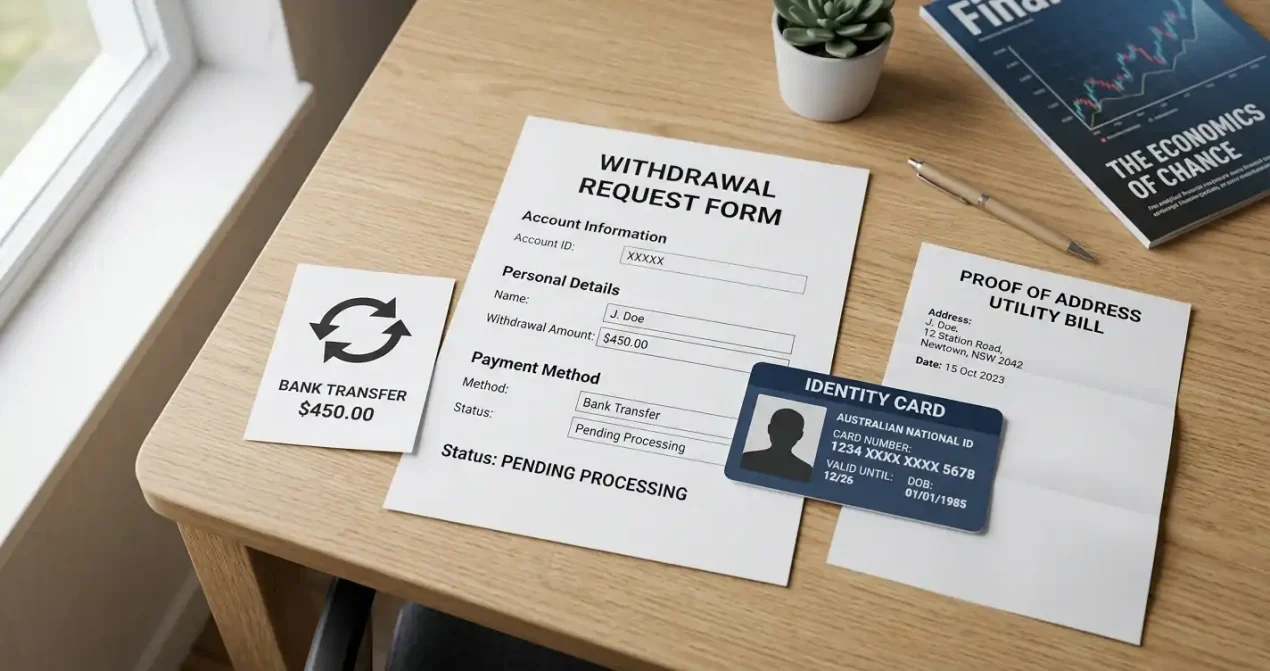
Jackpot Jill’s account information lists a standard identity-document set: a government-issued ID such as a passport, identity card or driver’s licence; proof of address no older than three months; and, where a registered credit card is involved, a card copy with sensitive digits obscured. These requirements belong to account verification rather than to a separate payment fee.
For a withdrawal, that distinction matters because the payment request and the identity check are related but different processes. A player can meet the monetary withdrawal floor while still having an account-verification step to complete. The account and KYC guide keeps the document set, support channels and account-control information together.
- Identity: passport, identity card or driver’s licence.
- Address: proof of address dated within the previous three months.
- Registered card where applicable: copy with sensitive digits obscured.
The document list is more informative than a generic statement that verification may occur because it identifies the kinds of evidence the product itself asks for. It also shows why payment ownership and account identity can intersect in the withdrawal path.
Each document category answers a different account question. Government ID ties the account to a person. Recent proof of address supplies an address check. A registered-card copy, where relevant, links a payment instrument back to the account while allowing sensitive digits to remain obscured. Treating those items separately makes the verification requirement easier to understand than collapsing them into a single “KYC” label.
The 1–48 hour window belongs to identity verification
Jackpot Jill describes account verification as usually taking 1–48 hours. That timing should stay attached to the task it actually describes: review of the account documents. It should not be repackaged as a promise that a withdrawal will be processed, approved or received inside the same window.
This separation prevents two different clocks from being blended into one. Identity review can finish before a payment provider completes its own processing, and a payment rail can have its own operational timing. The payment facts support the KYC range. Payout timing is a separate measure and should be kept separate from that identity-review window.
- Check whether the requested amount meets the stated withdrawal floor.
- Treat any required KYC review as a separate account-verification stage.
- Keep the 1–48 hour statement attached to verification rather than presenting it as a withdrawal guarantee.
This is also why the parent payment page is organised around constraints rather than convenience claims. The known figures say more about minimums and document checks than they do about speed.
Live chat and email are available 24/7 for account support
Jackpot Jill lists both live chat and email support as available 24/7. In payment context, that matters most as an account-support channel around verification questions, document requests or the status of an account check. It should not be converted into a claim that withdrawals themselves are monitored or completed around the clock.
The support fact also helps separate communication availability from payment performance. A player can have access to a support channel at any hour while a verification or payment process follows its own sequence. The two facts can coexist without one proving the other.
For document handling, the practical connection is straightforward: the account guide lists the same support channels alongside the KYC document set and account controls. That makes it the better destination for identity and account-management detail, while this payment overview keeps the money-movement constraints in focus.
- Live chat: listed as available 24/7.
- Email: listed as available 24/7.
- Scope here: support availability, not a payout-time metric.
Crypto adds transfer risk to the payment mix
Jackpot Jill presents a hybrid payment setup that includes fiat methods and a generic crypto category. For the payment overview, the important point is not a specific coin or network; it is that blockchain transfers bring an additional layer of price movement and irreversibility compared with conventional account balances.
A crypto transfer can change in fiat value while funds are held, and an incorrectly directed blockchain transaction can be difficult or impossible to reverse. Those are transaction-level risks rather than a claim about Jackpot Jill’s withdrawal performance. They belong beside the gambling risk because both can affect the amount ultimately retained by the player.
Crypto changes the risk profile of money movement even when the brand-specific record stays at the category level.
The games guide looks at session-cost risk from the play side; this section keeps the payment side focused on transfer exposure and withdrawal constraints.
The same separation applies to fees. A blockchain network cost, when one exists for a specific transfer, belongs to the network path rather than to the withdrawal minimum itself. Because the brand-level facts here do not attach a named asset or network to a withdrawal, the useful comparison remains qualitative: crypto can add market-value movement and transfer finality to an already risk-bearing gambling balance.
Australian availability limits the practical use of these payment facts
Online casino services are prohibited from being offered to people in Australia, so these withdrawal and KYC details describe the product rather than provide a route to use it; the Australian legal-status guide covers that restriction.
Questions about Jackpot Jill withdrawals
What is the minimum withdrawal at Jackpot Jill?
The general minimum withdrawal is $20. Bank Transfer has a higher stated minimum of $50.
What documents can Jackpot Jill request for verification?
The account information lists government-issued ID, proof of address no older than three months and, where applicable, a registered-card copy with sensitive digits obscured.
Does the 1–48 hour KYC range mean withdrawals arrive within 48 hours?
No. The 1–48 hour statement describes the usual identity-verification window. The 1–48 hour statement covers identity verification rather than payout speed.
Withdrawal thresholds and KYC are the clearest payment constraints
The payment picture here is straightforward: a $20 general withdrawal minimum, a $50 Bank Transfer minimum, a defined KYC document set and a usual 1–48 hour verification range. Those facts explain the cashout and account-check side while keeping payout timing and broader payment limits as separate questions. Deposit-specific funding facts now sit in their own page, keeping the two intents separate and easier to compare.
That split also improves the information hierarchy. The deposit page answers what the product names on the funding side; the payment parent answers what the stated cashout floors and identity checks mean once money is already in the account. Together they cover distinct stages without repeating the same list of methods and thresholds.
Jackpot Jill payments and withdrawal thresholds — More on this topic at Jackpot Jill review Australia.
See also Jackpot Jill deposit methods and minimum.
This material was created by the Jackpot Jill Guide Australia team.
Related posts

VPN-Friendly Casinos in Australia: What to Check

Uptown Pokies Casino Australia: Bonus Guide