
Separate useful checks from pokies marketing
A practical look at what game claims can establish, what venue searches can verify and where online play raises legal questions.
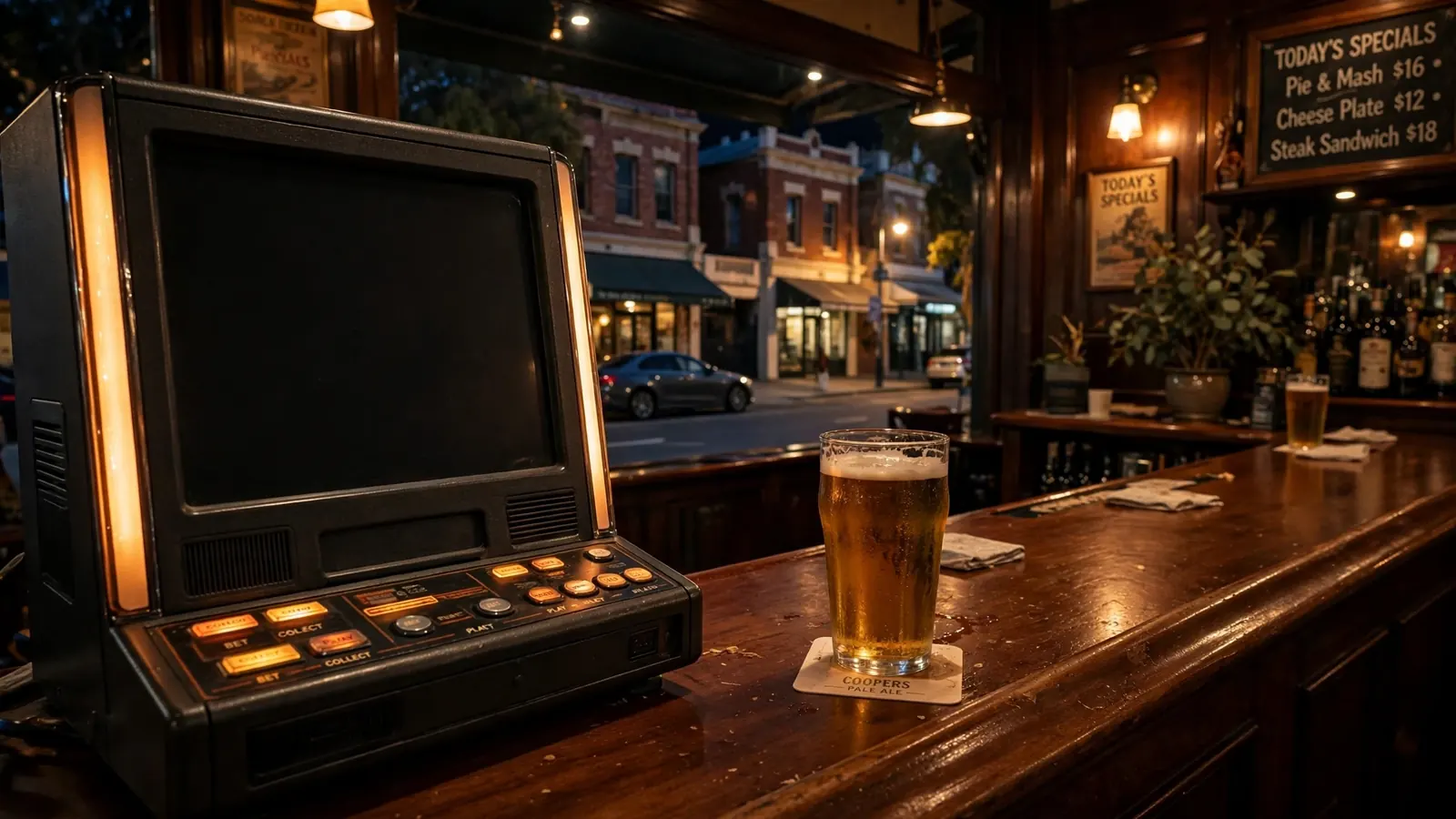
What “best pokies” can—and can’t—mean in South Australia
“Best” sounds like a verdict. With pokies, it can easily turn into an advertising word with very little behind it. A game title, a venue, a payout claim and a player’s lucky night are different things; lumping them together does not produce a useful ranking.
I’ve made the mistake of treating a big win story as evidence that a pokie must be better. It isn’t. Each spin is an independent event determined by a Random Number Generator. The result of one spin does not make a particular result more likely on the next, and a machine that has been quiet is not “due”. A memorable session can feel like a pattern. It is still just a session.
That matters when you see claims about the best-paying pokies in South Australia. A payout story tells you what happened to someone at a particular moment, not what you should expect. Nor does a popular title automatically pay more than another one. Without a reliable, comparable basis for the claim, “best paying” is a sales pitch, not a finding.
If you’re looking for online pokies options in South Australia in 2026, this list gives you a concise reference to the licensing and payment details available for each operator. Use those details as a starting point when deciding what to check further.
-
House of Pokies
- License
- international iGaming licence – jurisdiction not named in the source
- Payout speed
- PayID 1-24 hours
- Min. deposit
- A$30 (PayID from A$10)
You can consider House of Pokies if PayID payments matter to you: the stated payout speed is 1–24 hours, and the minimum deposit is A$30, or A$10 with PayID. Its source describes the licence as international but does not name the jurisdiction.
-
7Bit Casino
- License
- Curacao, operated by Dama N.V.
7Bit Casino is listed as operating under a Curacao licence, with Dama N.V. as its operator.
-
Rollero Casino
- License
- Curacao Gaming Control Board OGL/2023/176/0095 (Hollycorn N.V.)
Rollero Casino’s stated licence is Curacao Gaming Control Board OGL/2023/176/0095, held by Hollycorn N.V.
-
LevelUp Casino
- License
- Curacao eGaming OGL/2023/174/0082 (Dama N.V.)
- Min. deposit
- A$15
LevelUp Casino lists a Curacao eGaming licence, OGL/2023/174/0082, with Dama N.V. as operator. Its stated minimum deposit is A$15.
-
Golden Pokies
- License
- Curacao
Golden Pokies is listed with a Curacao licence; that is the only operator detail provided here.
-
WinSpirit Casino
- License
- Curacao eGaming OGL/2024/923/0383 (Antillephone N.V.)
- Min. deposit
- A$30
WinSpirit Casino lists Curacao eGaming licence OGL/2024/923/0383, held by Antillephone N.V. Its stated minimum deposit is A$30.
-
Vegaz Casino
- License
- Curacao OGL/2024/1335/0780
- Min. deposit
- EUR 20
Vegaz Casino lists Curacao licence OGL/2024/1335/0780. Its stated minimum deposit is EUR 20.
-
Playfina Casino
- License
- Curacao eGaming (Hollycorn N.V., since 2017)
- Min. deposit
- A$20-30 (depends on the offer)
Playfina Casino is listed with a Curacao eGaming licence and Hollycorn N.V. as operator since 2017. You’ll find its stated minimum deposit varies by offer, from A$20 to A$30.
-
Uptown Pokies
- License
- Curacao (operating since 2017)
- Min. deposit
- A$20
Uptown Pokies is listed as operating under a Curacao licence since 2017, with a stated minimum deposit of A$20.
-
Wild Tokyo
- License
- Curacao
- Payout speed
- crypto 30-60 minutes, fiat 1-5 days
- Min. deposit
- A$10
Wild Tokyo lists a Curacao licence and a A$10 minimum deposit. Its stated payout speed is 30–60 minutes for crypto and 1–5 days for fiat.
RTP is one measure people use when comparing games. It describes a theoretical return across play over time; it is not a prediction of what one person will get back during a visit. A figure attached to a game also needs context. A specialist review reports that some providers give casinos a choice of RTP settings for a pokie. So the same title may run with different return percentages at different casinos.
That is an important caveat, not a reason to chase a particular setting. A percentage without a clear explanation of which version it describes can create a false sense of precision. And even when a figure is clearly stated, it does not turn an individual spin into a predictable outcome. Long-run maths and tonight’s result are not the same thing.
Keep the comparison narrow. If someone calls a game “best”, ask what they mean: a published RTP setting, a particular feature, or simply a personal preference? Those are not interchangeable measures. If the claim does not say what is being compared, you cannot tell whether it says anything useful. That’s the bit I used to skip.
The same caution applies to searches for South Australian casino pokies or games in the CBD. A location in a phrase does not establish that a particular venue has a particular game, and the presence of a title does not establish its setting. I would not treat a list of popular names as a verified local ranking. Popularity is not a payout measure, and a venue label does not fill in the details.
There is a difference between “best for me” and “best by evidence”. You might prefer a simple layout, a certain theme or features you understand. Those preferences can help you decide what you find enjoyable, but they do not show that a game is more likely to pay. I’ve found that the word “hot” often makes a random result sound like a dependable trend. It isn’t one.
So, what can “best pokies in South Australia” reasonably mean? It can mean checking the exact claim being made and separating verifiable details from opinion. It can mean noticing whether an RTP figure refers to the same game version and setting being discussed. It cannot honestly mean that a title guarantees a return, that a recent win predicts another, or that a broad label proves one venue’s games are better.
If you are weighing up a claim, slow it down: identify what is being compared, what the claim actually measures, and whether it says anything about your likely result. Don’t let confident wording do the work of evidence. There is no reliable shortcut from a name or a story to a better outcome.
That is a less exciting answer than a ranked list. It is also a more honest one. A game can have features you like, and its published information may help you understand how it is described. But a ranking cannot remove randomness, and “best” cannot make a spin predictable.
No magic label.
Checking whether a venue is open right now
A listing that gives a venue’s opening hours is not the same thing as confirmation that its doors are open at this moment. Hours are a general schedule; “open now” is a live claim. If you are making a trip for pokies in South Australia, check the specific venue directly before setting out. Nothing in a search result alone can tell you whether it is operating right now.
I’ve made the mistake of treating a neat row of hours as a promise. It isn’t one. A directory entry may be old, may cover the venue’s main premises rather than its gaming area, or may not reflect a change made that day. Even an official page can give routine hours without saying whether there has been a temporary closure. Read what the page actually confirms.
Check the venue, not just the general hours
Start with the venue’s own current information, if it publishes any, and contact it directly if the answer matters to your plans. Be specific: ask whether the venue is open now and whether the area you intend to visit is available. A hotel, club or other venue can have several parts, and a general “open” label may not answer the question you actually have.
If you find opening times on a map or directory, treat them as a useful lead rather than live confirmation. Check whether the listing points to the right premises and whether its information appears current. Where details disagree, don’t pick the answer that suits your schedule. Confirm with the venue.
That small extra step beats arriving to find a closed door. Annoying, but simple.
Early and late opening claims
People looking for an early start or a late visit may see particular times in a listing and assume they apply across South Australia. They do not establish a statewide schedule. Opening arrangements are specific to each venue, and a time shown online may describe ordinary hours rather than the status on the day you plan to go.
So if you need to know whether somewhere is open early, late, or at a particular hour, ask that venue directly. Don’t infer its hours from another venue’s schedule, from a search snippet, or from the fact that a listing says “open.” If you cannot get a clear answer, plan as though the visit is unconfirmed rather than relying on it.
This is also why a general opening-hours page can be useful without settling the practical question. It may help you decide when to call or when a visit might be possible, but it cannot substitute for a current confirmation. Keep those two things separate.
Opening status is not a payout figure
A venue’s opening information does not tell you anything reliable about a pokie’s payout percentage. They are separate questions. A percentage shown in promotional material or a third-party listing should not be treated as proof of the setting on a particular machine at a particular venue. The same game can be offered with different return settings in different places.
Do
- Contact the venue directly
- Ask if the gaming area is open
- Verify the specific premises
Don't
- Rely on general search results
- Assume directory hours are live
- Infer status from other venues
Nor does a venue being open mean that every machine or facility is available. If a particular detail matters to you, confirm that detail directly instead of reading it into the opening-hours result. A general status label can only answer the narrow question it actually covers.
I know the temptation to get a quick yes or no, especially when you are already on the way. But “open now” is only useful when it is current and about the right place. The safest check is the boring one: contact the venue, confirm the timing, and make your decision from that answer.
Pokies near the airport: what this guide can verify
Airport-area searches are about a particular place, not South Australia as a whole. Someone arriving, leaving or waiting nearby may want to know whether there is a pokies venue within reach.
That matters because search results can blur distinct locations. A result for a city, suburb or wider region may appear alongside an airport-related search without being close to the terminal. The same goes for results mentioning “central” or “north”: those words can point to different areas, and they are not a substitute for a checked address. No invented distance or travel time makes that clearer.
If you’re trying to establish whether a particular place is genuinely near an airport, start with its exact street address and compare it with the airport’s own address or map. Check that the listing refers to a physical venue, not an online service, an old directory entry or a place elsewhere with a similar name. A map pin is a lead, not proof that the venue exists or offers pokies. I’ve learned not to mistake a tidy result page for a checked fact.
A location label is not confirmation.
It also helps to keep “near the airport” separate from “near the CBD”. Those describe different location searches; neither one supplies a reliable list of venues for the other. A result that uses broad wording such as “near me” depends on where you are and how the service interprets your location. It can surface places outside the area you had in mind. Read the address, not just the headline.
For searches that mention a different state, town or suburb, check that the place is actually in South Australia before treating it as relevant. Familiar-looking names can occur in more than one region. A query that combines South Australia with another place name may reflect a boundary, a mistaken location or simply imprecise wording; it does not confirm that a venue is nearby.
There is another distinction worth keeping straight. A physical venue search is not the same as a search for online pokies. Real-money online casino games, including pokies, cannot lawfully be offered to people in Australia by operators without a domestic licence, and no Australian-licensed online casino exists. A website using airport or South Australian wording does not turn an online service into a local venue.
I would treat an airport-area claim as unconfirmed until the venue itself can be identified by a real address and its location checked independently. If there is no precise place to check, there is no sound basis for saying it is “near” the airport. That is less satisfying than a list, but a made-up list would be worse.
Online pokies and deposits: the legal reality for Australians
An online search for real-money pokies can make a site look like an ordinary place to play. The legal position is less comfortable. Under the Interactive Gambling Act 2001, companies cannot lawfully provide real-money online pokies to people in Australia without a domestic licence. No Australian online casino licence has been issued, so there is no locally licensed online casino to point to.
That does not mean every site a South Australian can reach is lawful or protected. Some offshore operators may accept Australian customers, but access is not the same as Australian oversight. If one refuses to pay winnings, you have no legal recourse in Australia to make it pay. I would not treat a polished website, a familiar game or a deposit button as a substitute for that protection.
“No deposit” still means read the conditions
A no-deposit offer can sound like a way to try a game without risk. The label alone tells you very little about what you could withdraw, or what you would have to do first. Bonus terms may attach wagering requirements: a turnover multiplier that sets how much qualifying play is needed before winnings can be withdrawn.
A specialist review uses 35x or lower as a point to look for and describes requirements above 40x as punishing. That is a reviewer’s assessment, not a legal standard or a promise that an offer is worthwhile. Read the actual terms rather than relying on the banner. Check what the multiplier applies to, which games count, and whether a withdrawal is conditional on completing the requirement. If those details are unclear, the “free” label is not enough to make the offer clear.
The same applies to a large maximum bet or a claim that a pokie pays well. Neither tells you what will happen on your next spin. Each spin is random; a high limit does not turn it into a better prospect. I used to read a confident headline as useful information. It wasn’t.
Depositing does not make a site safer
A payment option only explains how money might move. It does not establish that an online casino is licensed in Australia, that a game is fair, or that a withdrawal will arrive. Before entering payment details, consider whether you are willing to risk losing the deposit and whether you understand the site’s withdrawal conditions. Don’t send money simply because a bonus clock or promotional message makes the decision feel urgent.
Also check what identity documents the operator requires before a first withdrawal. Be prepared for identity and address proof; a request at that stage can affect whether you can access funds. Do not assume that depositing successfully means you have solved that issue.
BetStop is a useful boundary to understand, not a shield for every website: it applies to Australian-licensed operators and does not bind offshore sites. Since Australia has no licensed online casino, an offshore site cannot become locally supervised just by accepting a payment method or displaying a bonus. The legal gap matters. So does the fine print.
What to know about gaming venues and machine oversight
When you’re weighing up a venue, a polished room or a confident “responsible” label doesn’t tell you what staff are required to do when someone appears to be struggling. The useful details are the procedures behind the claim: who is on duty, what happens when a concern is raised, and whether the venue records incidents.
One reported measure concerns venues operating more than 20 gaming machines. A report by regionriverina.com.au says those venues are required to have a dedicated responsible gambling officer (RGO) on duty while the machines are running. The report also describes a one-month grace period for venues to introduce the officer role and remove signage. That is a report of a particular measure; it should not be read as proof that the same requirement applies to every venue in South Australia.
The distinction matters. “Dedicated” suggests a specific responsibility, not simply that someone somewhere on the premises can be asked for help. If you want to understand what a venue actually does, you can ask who the RGO is during machine operating hours and how patrons can speak with them. A venue’s answer may tell you more than a promotional slogan. Still, asking is not the same as independently confirming compliance.

A separate reported obligation is a gambling incident register. The report says venues will be required to record occurrences, including behaviour that indicates a patron may be at risk of gambling harm or already affected by it. The point is not that every difficult moment becomes a formal incident. It is that concerns of this kind are meant to be documented, rather than left entirely to someone’s memory after the event.
That record-keeping requirement is about venue handling, not a promise that harm will be prevented. An officer and a register cannot undo a loss or guarantee a particular response. They are safeguards to ask about, not reasons to assume a venue is safe for you personally. I learned that the hard way: a reassuring phrase can sound like protection when it is only a description of a process.
For anyone comparing South Australian pokies venues, keep the question narrow and practical. Ask what support is available on site, how to reach the responsible gambling officer, and what happens if staff notice signs of harm. Then judge the answer on its clarity, not on the word “best”. I would rather hear a plain explanation than a grand claim.
These details also do not tell you where a venue is, whether it is open, or what machines it has. They concern oversight inside a venue. If you are already worried about your own gambling, stepping away and seeking support matters more than testing whether a venue’s procedures work.
A 24-hour claim is not the same as verified opening hours
“Open 24 hours” sounds definitive, but it is a claim that needs checking, not proof that pokies are available around the clock at a South Australian venue. Opening hours can refer to a whole venue, while gaming areas may have different access arrangements. A result or listing may also be out of date. I’ve learnt not to plan a late trip around a label alone.
For current access, confirm directly with the venue before setting out. Ask whether the venue is open at the time you intend to arrive and whether its gaming area is operating then. General opening information cannot confirm what is happening on a particular night. No guesswork.
A venue’s opening hours also do not have to dictate how long you play. When I’ve kept going just because I was already there, “one more spin” had a way of stretching the session. Decide your stopping point before you start, and treat it as a limit rather than something to renegotiate when you’re tired or chasing a result.
Responsible-gambling tools can help put boundaries around play: deposit limits, loss limits, session time limits and self-exclusion options. They address different parts of the decision. A time limit helps you plan when to stop; a loss limit puts a boundary on what you are prepared to lose. Self-exclusion is an option for stepping away, not a way to make a long session safe.
I’d keep the practical check simple: confirm opening information directly, work out how you’ll get home, and set a clear end time before playing. If you find yourself moving that end time or raising a limit, take that as a reason to stop rather than an invitation to keep going. Being able to play later does not mean you need to.
A claim about round-the-clock access is not a reason to ignore your own limits. Whether the doors are open or not, you can leave.
Searching for Crown in South Australia
Crown-related searches can blur two different things: a brand name and a South Australian venue. I can’t confirm a Crown venue or Crown pokies in South Australia, so I wouldn’t treat the name appearing beside the state as proof that there’s a local room to visit. Search results can join places, brands and old references in ways that look more definite than they are.
That matters if you’re looking for a particular pokies room. A familiar brand might make a venue sound like a safe bet, but the name alone tells you nothing about whether a place is actually in South Australia, what machines it has, or whether it is open. I’ve learned not to plan a night around a listing until I can match it to a current, direct venue source. A map pin or a repeated snippet isn’t enough.
The same goes for claims about the “best” Crown room in the state. Without a confirmed South Australian Crown venue to compare, a ranking would be theatre, not useful guidance. Even where a venue is real, “best” depends on what you mean: the atmosphere, location, access, or something about the machines. None of those can be settled by a brand label alone.
If your real concern is a maximum cash payout on pokies, don’t assume there is one figure that applies across a brand or across South Australia. I can’t give a Crown-specific maximum for the state. A payout claim needs to be tied to the actual venue and the applicable machine or prize rules; otherwise, it’s just a number without context. I wouldn’t make a trip or a spending decision on that basis.
There’s also a difference between a physical venue and an online casino using a familiar name. The Australian Communications and Media Authority (ACMA) enforces the Interactive Gambling Act 2001. A brand reference does not establish that an online service is authorised to provide real-money casino games to people in Australia, or that it is a South Australian venue. Keep those questions separate.
When I check a Crown-related claim, I look for direct confirmation of the location and the exact service being described. If that trail is unclear, I leave the claim unconfirmed rather than fill the gaps with assumptions. That’s less exciting than a confident list. It’s also how you avoid arriving somewhere that exists only in a search result.
CBD and club searches: don’t mistake a query for a venue list
A CBD address or a club name in a search result does not tell you whether that place has pokies. It may point to a general directory, an old listing or a page about the area rather than a particular venue. I’ve learned not to treat a promising label as confirmation. Check the venue’s own current information before making plans, and ask directly if the detail you need is not clear.
The same goes for South Australian clubs. A mention of a club in a discussion or map listing is not proof that it offers gaming. Nor does a page calling somewhere “the best” explain what that judgement is based on. Without dependable details about the venue and its facilities, there is no honest shortlist to hand you.
That can feel like a frustrating answer when you want a simple CBD recommendation. Still, a confident-sounding list can waste your time if its entries are inaccurate or out of date. Separate the place itself from the claim about pokies, then confirm both before you go.
Age matters, too. In Australia, you must be at least 18 to gamble, including on online pokies. That is a legal threshold, not a suggestion, and a venue’s location or club status does not change it. If you are under 18, do not try to gamble there.
If self-exclusion is the reason you are checking local options, don’t assume that a general venue page explains how it works. Contact the venue and ask what arrangements are available and what steps they require. Get the answer directly rather than relying on a passing mention or someone else’s account. I would rather spend a minute confirming than make an assumption when the subject is keeping myself away from gambling.
Do CBD or club search results guarantee pokies are available?
No, a CBD address or club name may point to a general directory or old listing and does not confirm the presence of gaming machines.
What is the legal age for gambling in Australia?
You must be at least 18 years old to gamble, including on online pokies.
How should I handle self-exclusion at local venues?
Contact the venue directly to ask about available arrangements and required steps rather than relying on general web pages.
A search result can help you find a place to contact. It cannot, by itself, establish that a club has pokies, that the details are current, or that a particular venue suits you. Treat claims as claims until the venue confirms them. No shortcut there.
Cashless play and searches beyond South Australia
“Cashless” can describe how a payment is made; it does not tell you whether a gambling service is lawful, safe or honest. I used to treat a familiar payment logo as a kind of reassurance. It isn’t. A payment feature cannot verify a venue’s machines, a game’s settings or a service’s standing.
PayID is an alias layer connected to the New Payments Platform (NPP). It lets people direct a transfer using an email address, mobile number or Australian Business Number instead of entering the recipient’s bank details. The NPP is supported by all major Australian banks, and PayID transfers use end-to-end encryption.
Those details explain the payment system, not what sits behind a request for money. Encryption protects the transfer in transit; it does not certify the recipient or turn a gambling service into a licensed one. Nor does a cashless option establish that a particular South Australian venue has pokies or accepts a certain payment method. Keep those questions separate.
The same goes for a mention of Newcastle alongside South Australia. Newcastle is in New South Wales, not South Australia, so a result tied to that city is not evidence about South Australian venues. Don’t let the shared word “pokies” blur the location. Check the place itself through reliable, direct information rather than assuming a cashless feature connects the two.
For me, that distinction is the useful bit: PayID describes a way to address a bank transfer. It is not a quality mark. A payment method can be technically secure while the service asking for a payment remains unverified. Cashless does not mean checked.
South Australian pokies: the limits of what can be recommended
I know the appeal of a straight answer: name the best pokies in South Australia, point to a venue, and be done with it. But a confident list is only useful if it rests on something that can be checked. I can’t responsibly rank particular games, venues or products here, so I won’t dress guesses up as recommendations.
“Best” can mean different things to different people: a game’s features, how a venue feels, or simply what is available when you arrive. Without reliable details to compare, a ranked list would tell you more about whoever wrote it than about what you might find. I’ve made the mistake of treating a polished claim as proof. It isn’t. Not even close.
For a game, a familiar title alone doesn’t establish the return setting used at a particular casino; providers can offer different RTP settings for the same pokie. Nor does a venue name tell you what machines it has or whether they suit your preferences. Those are separate things to verify, not reasons to trust a “top pick”.
If gambling is becoming hard to control, BetStop is worth understanding accurately: it applies to Australian-licensed operators and does not bind offshore sites. It is not a safeguard that follows you to an offshore service, and it should not be read as an endorsement of one. Australian law prohibits companies from providing real-money online casino games to people in Australia without a domestic licence, and no such licences have been issued.
So I’d rather leave a ranking blank than pretend it is evidence-based. Check claims before acting on them, and step away if play stops feeling manageable. A list can wait. Your limits matter more.
Are online pokies legal for Australian players?
Yes, Australians can legally play on offshore sites that accept them, but companies cannot legally offer real-money online pokies to Australian residents without a domestic licence, and none have been issued. If an offshore casino refuses to pay, you have no legal recourse in Australia.
How do I know if an online casino is safe to play at?
There is no Australian-licensed online casino, and you have no legal recourse in Australia if an offshore casino withholds your winnings. Keep that risk in mind before using an offshore site.
What is the cost-benefit calculation of casino promotions?
Check the wagering requirement and what it applies to before accepting a promotion. For example, a $500 bonus with a 40x requirement means $20,000 in bets before you can withdraw winnings; if the 35x requirement applies to a $500 deposit plus a $500 bonus, it means $35,000 in bets. Free-spin winnings may also have a cash-out cap.
Can casinos change the RTP of their games?
Yes. Some providers let casinos choose from multiple RTP settings for the same game, so check which setting a published figure refers to.
What is the legal age for online gambling in Australia?
You must be 18 or older to gamble online in Australia.
Are online pokies rigged?
Each spin is an independent random event determined by a Random Number Generator, so a previous result does not predict the next one. Some games can have different RTP settings at different casinos, but that alone does not show that a game is rigged.