
What an offshore licence can—and can’t—tell you
A Curaçao connection describes a site’s claimed status, not whether it is licensed to operate in Australia or what protections apply.
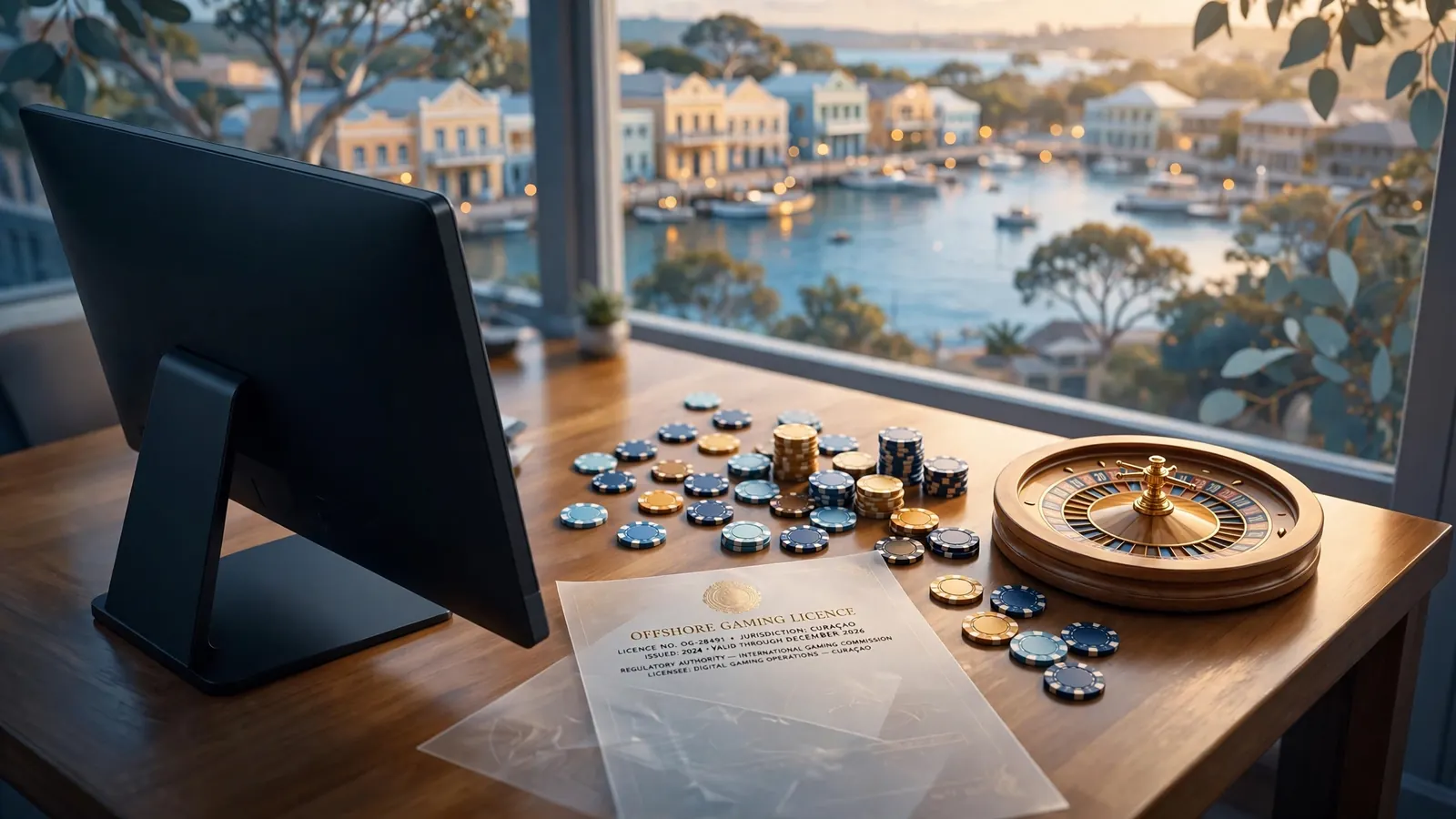
What “online Curacao casino” means for Australian players
When someone says “online casino in Curaçao”, they usually mean a gambling website associated with Curaçao in some way: perhaps the operator says it is based there, or presents itself as holding a Curaçao offshore licence. The phrase describes the site’s claimed connection, not where you are playing from. You can be sitting in Australia and using a website that markets itself as Curaçao-linked.
That distinction matters. A casino’s offshore identity does not make it a service licensed to operate in Australia. The word “licensed” can sound like a simple stamp of approval, but it only tells you something about the authority the operator says oversees it. It does not turn an offshore casino into an Australian-licensed service.
I used to read the place name as if it settled the question. It doesn’t. It tells you what the casino is claiming about its connection, not what Australian law permits.
Casino games are not the same as every kind of gambling
“Online casino” is often used loosely, as though it covered any gambling website. It does not. In ordinary use, the phrase points to games such as online slots, blackjack and other casino-style table games. Those are different products from wagering on sports or other events, even if a single website presents both under one account or menu.
If you’re considering a casino with a Curaçao licence as an Australian player in 2026, check the licence details and practical terms available for each option. The entries below highlight only the information provided for each operator.
-
House of Pokies
- License
- international iGaming licence – jurisdiction not named in the source
- Payout speed
- PayID 1-24 hours
- Min. deposit
- A$30 (PayID from A$10)
House of Pokies lists an international iGaming licence, but the jurisdiction is not named in the available information. PayID payouts are listed at 1–24 hours, with a A$30 minimum deposit or A$10 via PayID.
-
7Bit Casino
- License
- Curacao, operated by Dama N.V.
7Bit Casino is listed as Curaçao-licensed and operated by Dama N.V. Those details identify the stated licence jurisdiction and operator.
-
Rollero Casino
- License
- Curacao Gaming Control Board OGL/2023/176/0095 (Hollycorn N.V.)
Rollero Casino lists a Curaçao Gaming Control Board licence, OGL/2023/176/0095, and names Hollycorn N.V. as the operator.
-
LevelUp Casino
- License
- Curacao eGaming OGL/2023/174/0082 (Dama N.V.)
- Min. deposit
- A$15
LevelUp Casino lists a Curaçao eGaming licence, OGL/2023/174/0082, with Dama N.V. as operator. Its stated minimum deposit is A$15.
-
Golden Pokies
- License
- Curacao
Golden Pokies is listed as Curaçao-licensed. No further licence or payment details are provided here.
-
WinSpirit Casino
- License
- Curacao eGaming OGL/2024/923/0383 (Antillephone N.V.)
- Min. deposit
- A$30
WinSpirit Casino lists a Curaçao eGaming licence, OGL/2024/923/0383, held by Antillephone N.V. The stated minimum deposit is A$30.
-
Vegaz Casino
- License
- Curacao OGL/2024/1335/0780
- Min. deposit
- EUR 20
Vegaz Casino lists Curaçao licence OGL/2024/1335/0780. Its stated minimum deposit is EUR 20.
-
Playfina Casino
- License
- Curacao eGaming (Hollycorn N.V., since 2017)
- Min. deposit
- A$20-30 (depends on the offer)
Playfina Casino is listed as Curaçao eGaming-licensed, with Hollycorn N.V. and a stated history dating back to 2017. The minimum deposit is A$20–30, depending on the offer.
-
Uptown Pokies
- License
- Curacao (operating since 2017)
- Min. deposit
- A$20
Uptown Pokies is listed as Curaçao-licensed and operating since 2017. Its stated minimum deposit is A$20.
-
Wild Tokyo
- License
- Curacao
- Payout speed
- crypto 30-60 minutes, fiat 1-5 days
- Min. deposit
- A$10
Wild Tokyo is listed as Curaçao-licensed, with a A$10 minimum deposit. The stated payout speeds are 30–60 minutes for crypto and 1–5 days for fiat.
That difference is useful when reading a site’s description. A service might promote itself as a betting platform, a casino, or both. The label does not change the nature of the product: a slot game remains an online casino game even if it appears beside sports markets or is described with softer language.
The rules in Australia distinguish between gambling products too. The Interactive Gambling Act 2001 prevents operators based in Australia from offering online casino games to people here. Online slots and casino games such as blackjack are illegal in Australia. So an offshore casino’s association with Curaçao does not make the same games lawful for an Australian operator to provide.
That is the basic shape of the issue. Casino games are not simply another name for all online gambling, and an overseas label does not erase the Australian rules that apply to the service.
What the Curaçao wording does—and doesn’t—say
You may see several versions of the same idea: a Curaçao online casino, an online casino licensed in Curaçao, or a casino “based” there. These phrases can blur together, but they are not necessarily making identical claims. One may point to the operator’s location; another may refer to an offshore licence; a third may just be branding.

For an Australian player, the shared point is that the wording refers to an offshore connection. It does not mean the casino has permission to offer online casino games under Australian law. Nor does the phrase itself tell you whether the operator is physically located on the island, where its company is registered, or which authority has oversight. Those are separate details, not things you can safely infer from a name or banner.
I’ve seen how easy it is to let a confident-looking label do too much work. “Curaçao” can sound official and specific. But a place name is not an explanation of the service’s status in Australia. Keep those ideas apart.
The distinction also works in reverse: not every website that offers casino-style games to Australians will describe itself using Curaçao wording. The label is about an asserted connection, not a complete category of every offshore gambling site. The game type and the operator’s legal position are separate questions.
Why the Australian setting still matters
If you are in Australia, the site’s overseas branding does not change where you are or the rules relevant to an operator offering online casino games to you. The Interactive Gambling Act 2001 applies to the provision of those services to people in Australia. An offshore casino may present its own terms and identity, but that presentation does not convert the service into one licensed to operate here.
It is also worth not mixing up “available to visit” with “authorised to provide”. A page may load, display games or accept account registrations; none of those things, by themselves, establish that the service is licensed in Australia. The mere fact that a site uses the phrase “Curaçao casino” is not a legal status for Australian players.
I wouldn’t treat the country name as a shortcut. It is a clue to the operator’s claimed offshore connection, and no more than that.
So, in plain terms, an online Curaçao casino is an offshore online casino associated with Curaçao, rather than a casino licensed to operate in Australia. The games being discussed are casino products such as slots and blackjack, not a catch-all term for every form of online wagering. And for Australians, the legal boundary around online casino games remains relevant even when the website’s branding points somewhere else. The label travels. The rules don’t.
A Curaçao licence is not an Australian licence
A licence claim can sound reassuring while answering the wrong question. A casino may describe itself as licensed in Curaçao, but that does not mean it is licensed in Australia. The two claims refer to different jurisdictions, and one cannot stand in for the other.
I find it helps to read the word “licensed” with the location attached. Licensed where? By whom? For what kind of service? Without those details, the badge is just a claim on a webpage. Even if an offshore licence is genuine, it does not give an online casino permission to offer casino games to people in Australia.
That distinction matters because Australian authorisation is not a general stamp of quality. It is a question of whether a service holds a valid Australian licence for a gambling product that may lawfully be offered here. The Interactive Gambling Act 2001 prohibits domestic operators from offering online casino games to Australian residents. So a Curaçao licence does not turn an offshore online casino into an Australian-licensed service.
What the Australian register can tell you
ACMA directs Australians to its website and public register to check which wagering services hold a valid Australian licence. The register is a place to verify a claim about Australian authorisation—not a directory of offshore casino licences or a way to approve an online casino that is not permitted to serve Australian customers.
If a service says it is licensed in Australia, look it up through ACMA’s public register rather than relying on its own wording. Check the service’s identity carefully and make sure the listing corresponds to the service you are assessing. A similar name or a copied logo is not the same as a matching register entry.
Then check what the authorisation covers. A listing for a wagering service does not mean every gambling product is permitted, and it does not convert an offshore casino’s Curaçao claim into local approval. The useful question is whether the particular service and product are authorised under Australian law—not whether a page displays a licence badge somewhere.
ACMA has urged players to use its website and the national register to understand which gambling products are legal in Australia. That is a more grounded starting point than treating a casino’s own “licensed” label as the final word. It keeps the jurisdiction in view.
Do
- Use ACMA's public register to verify Australian licensing claims
- Check that the service identity matches the register entry
- Verify which specific products the authorisation covers
Don't
- Rely on a website's own wording regarding local licensing
- Treat a Curaçao licence as a substitute for Australian approval
- Assume a similar name or logo equals a matching register entry
Two claims, two different meanings
“Curaçao-licensed” describes an offshore licensing claim. “Licensed in Australia” is a separate claim that should be checked against ACMA’s public register. They are not interchangeable, even when a website presents them side by side or uses broad wording such as “internationally regulated.”
An offshore licence might tell you that an operator says it is authorised somewhere else. It does not establish Australian authorisation, and it does not tell you that Australian law permits the operator to provide online casino games to residents here. For that, the local legal position matters. A foreign badge cannot override it.
I used to read a licence logo as if it settled the whole question. It doesn’t. A logo can be easy to display; what matters is whether the specific claim can be verified with the relevant regulator, and whether it answers the question you actually need answered. For Australian authorisation, that means ACMA’s register—not an offshore badge.
Don’t let the word “licence” do too much
When a site names Curaçao, keep the claim in its proper lane. It is not proof that the service is licensed in Australia. It is not evidence that the service can legally offer casino games to Australians. And it is not a substitute for checking the Australian register when a service claims to hold a local wagering licence.
The register is most useful when you treat it as a verification tool, not a quality rating. An entry can help establish whether a wagering service holds an Australian licence; it does not make an unrelated offshore casino authorised, and it does not change which products may be offered here. Read the service name and the product claim together.

If you cannot match an Australian licensing claim to ACMA’s public register, do not treat the claim as established. And if the site points instead to a Curaçao licence, that answers a different question. Keep the categories separate. That’s the whole check.
The legal position in Australia, without the sales pitch
The legal question is less complicated than the wording on a casino’s website makes it sound. The Interactive Gambling Act 2001 targets operators that provide real-money online casino games to people in Australia. A Curaçao licence does not change that Australian rule or turn an offshore site into a service licensed in Australia.
ACMA is the main regulator for online gambling here. It can take enforcement action against operators that breach the Act, including issuing fines, and it can ask internet service providers to block access to sites offering prohibited gambling services to Australian customers. ACMA may also issue a blocking order as a last resort when it considers customer safety to be at risk. A site being reachable today is not proof that it is authorised or that access will remain available.
There is an important distinction for players. The Act does not explicitly make individual players criminals simply for using an offshore casino site. That is not the same as saying the service is legal to offer in Australia, approved by ACMA, or endorsed by the government. The law’s focus on operators should not be mistaken for a stamp of safety on the site.
I used to read “available to Australians” as if it meant “allowed in Australia”. Those are not the same thing. A foreign licence may describe the operator’s position elsewhere; it does not override Australian law. And a block, or the absence of one, is not a verdict on whether the casino will treat you fairly.
So keep the two questions separate: what the operator claims about its offshore licence, and whether it is authorised to provide online casino games to people in Australia. The first does not answer the second. No local approval.
What “Curacao casino” tells you—and what it doesn’t
When a site describes itself as a Curaçao casino, the phrase tells you how the operator wants you to understand its connection to Curaçao. It may be presenting itself as an offshore gambling business associated with that jurisdiction. But the label, by itself, does not tell you exactly what has been authorised, which entity is responsible for the site, or what rights you would have if there were a dispute.
That distinction matters because a familiar-sounding label can do a lot of work in very few words. “Licensed” sounds like a complete answer. It isn’t. A claim about an offshore licence is not the same thing as being licensed in Australia, and it does not make online casino games authorised for Australian residents. The wording on a site cannot change that.

I used to give these labels more weight than they deserved. If the site placed a jurisdiction name beside the word “licence”, I treated it as a kind of stamp of approval. That was an easy shortcut—and a poor one. A label is a claim to interpret, not a guarantee to rely on.
One phrase, several possible meanings
“Curaçao casino” is broad wording, not a precise description of a particular arrangement. It might refer to a casino brand that claims an offshore licence. It might appear in advertising, in a site’s terms, or in a description written by someone else. Those uses do not necessarily establish the same thing.
Even the phrase “Curaçao casino licence” leaves important questions unanswered. Which business is named? Does the claim relate to the website you are using, or to another company in the same group? What activity does the claimed permission cover? Is the information current and verifiable? The words alone do not settle any of that.
Nor does the word “Curaçao” tell you that the operator is accountable to Australian authorities as an Australian-licensed gambling service. A place name can describe the operator’s claimed offshore connection; it does not move the service into Australia’s regulatory framework. That is the part I now make myself separate in my head.
The distinction is easy to lose when the same phrase appears in a site’s branding, a promotional page, and a licence claim. Repetition can make a statement feel established. It still needs evidence.
What the label cannot promise you
Most importantly, an offshore label cannot promise Australian consumer protection. A service without the required Australian authorisation does not gain Australian protections simply by displaying a foreign licence claim. If a dispute arises, or winnings are withheld, Australian laws may not help you get the outcome you expect.
That is not a prediction that every offshore operator will withhold winnings. It is a limit on what you can safely infer from the label. A claim about licensing does not, on its own, tell you what complaint process applies, whether a decision can be challenged, or whether you can enforce a payment claim from Australia. Those are practical questions, not details that a jurisdiction name answers.
There is a difference between an operator saying it follows rules somewhere and you having a usable remedy here. I wish I had understood that before treating a licence claim as a substitute for checking who stood behind a site and what protections actually applied to me. The label can sound reassuring without answering the question that matters when something goes wrong.
And there is no reason to assume that a polished website, familiar game imagery, or formal-sounding wording fills those gaps. Those features may shape how a service presents itself. They do not establish Australian authorisation or create consumer rights.
Read the words as a claim, not a conclusion
When you see “casino Curacao” or similar wording, try translating it into a more careful sentence: “This site claims an offshore connection to Curaçao.” That wording is less impressive, but it keeps the claim in its proper place. It does not quietly turn the claim into “this site is approved for Australians” or “I am protected if there is a dispute.”

The same applies when a page uses “licensed casino” without making clear which company or service the statement covers. A licence claim is only as useful as the information behind it. Until you know what it refers to, the headline does not tell you enough to make a decision.
This is not a recommendation to use a site if its claim sounds convincing. Online casino games are not authorised for Australian residents simply because an operator describes itself as licensed offshore. The label does not override the rules that apply here, and it does not offer a workaround to them.
I now read these phrases more narrowly than I used to. Curaçao may be part of an operator’s claimed identity or licensing story. That is all the phrase establishes by itself. It does not establish that the service is licensed in Australia, that Australian consumer protections apply, or that a player has an effective remedy if a payment is disputed.
Small wording. Big difference.
How to assess casino claims when there’s no trustworthy shortlist
A page calling itself one of the “best” Curaçao casinos has made a marketing claim, not done your checking for you. I used to treat a confident ranking and a neat-looking site as a decent shortcut. That was lazy. A list can repeat what an operator says about itself without showing how any claim was confirmed.
Verifying Claims
-
1
Identify the entity
Find the legal entity named on the site and the specific licence details provided.
-
2
Check official records
Cross-reference the licence number and entity name against the relevant regulator’s official records.
-
3
Confirm the match
Ensure the record matches the operator exactly; do not accept a number in a footer as standalone proof.
Start with the specific claim, not the site’s overall polish. If it says it holds a Curaçao licence, look for the legal entity named on the site and the licence details it provides. Then check the number and entity against the relevant regulator’s official records. The details should match; a number printed in a footer is not proof by itself. If you cannot verify it, or the record does not match the operator, do not treat the claim as established. Walk away.
Even a genuine offshore licence claim does not mean the service is licensed in Australia. Checking a foreign licence is not a way to turn an offshore casino into an authorised Australian service. Nor does a regulator’s record tell you, by itself, how a dispute with the operator would be handled. Keep those questions separate.
Read the terms that sit behind the headline claims. Look for the company responsible for the site, its stated rules for accounts and withdrawals, and whether the wording is clear enough to understand before you hand over documents or money. If key details are missing, contradictory, or buried under vague promises, count that as a reason to stop—not as a puzzle you need to solve in the operator’s favour.
Identity checks deserve the same attention. Casinos conduct KYC checks and require identity verification before withdrawals. A request may include photo ID, proof of address, and proof that you own the payment method used. That can be a normal part of verification, but it is still sensitive information. Before sending anything, check who is collecting it, how the request is made, and whether the instructions match the operator’s published process. A rushed demand or a request through an unrelated channel should make you pause.
Do not assume that completing verification guarantees a withdrawal. It only means you have supplied information for review; it does not prove that every other term has been met or that a dispute will be resolved in your favour. I learned the hard way that a reassuring phrase on a page and a useful remedy are two different things.
The same goes for familiar-looking badges, glowing testimonials, or a professional design. They may make a site feel established, but they do not verify its licence, its operator, or its promises. A badge is worth considering only if you can trace it to the organisation it claims to represent and confirm what it actually verifies. Otherwise, it is decoration.
There is no honest shortcut that turns a “top” label into a trustworthy shortlist. Check claims one by one, and be willing to stop when the evidence is thin. For Australians, an offshore casino without the required Australian authorisation is not made legitimate by a polished site or a licence claim. Unlicensed gambling services lack consumer protections, and Australian laws may not help if winnings are withheld. That is the part the sales copy tends to leave out.
“Gaming” claims, game returns, and the details worth checking
When a site talks up its “gaming” range, I look past the catalogue and check what the game itself says. A polished title, familiar artwork or claim that a game is popular tells you little about its return. For a pokie, the useful place to start is its RTP information.
- RTP
-
A published measure of how much a game is designed to return to players over time, expressed as a percentage.
RTP means return to player: a published measure of how much a game is designed to return over play, expressed as a percentage. It is not a forecast of what you will get back in one session, and it does not promise that a particular spin will pay. I used to read a high RTP as if it settled the question. It doesn’t. It describes the game’s stated return setting, not your result.
To find the figure, open the pokie’s information or help screen. The control is often an “i” icon or a menu button. Read the game’s own details rather than relying only on a casino’s promotional description. If the RTP is not displayed there, don’t fill the gap with an assumption based on the game’s name or appearance.
There is another detail that is easy to miss: a provider may release the same game in more than one RTP version. The operator chooses which version to run. So seeing a familiar title does not, by itself, tell you which return setting is active. Check the information screen on the version you are actually being offered.
That is a more useful check than treating “Curacao gaming casinos” as if the label tells you something about every game inside. The label does not identify a game’s RTP version. A casino’s page may describe the selection in broad terms, but the game’s own help or information screen is where I would look for the specific figure.
If you compare games, compare the displayed RTP settings, not just the titles. Keep in mind what the figure can and cannot tell you: it is a game detail, not a guarantee of a win or a measure of how a particular session will go. Small distinction. Big one.
Are Curaçao casinos safe? Start with the limits of the word “safe”
“Safe” can mean that a website encrypts information, that an operator handles money fairly, or that you have somewhere to turn if a dispute goes badly. Those are different things. I used to see a padlock icon and treat it like a character reference. It isn’t.
Casinos use SSL encryption to protect transactions and sensitive information while they move between your device and the site. That is a useful technical safeguard: it can help prevent data being read in transit. But it tells you nothing by itself about whether the operator will pay a withdrawal, handle a complaint fairly, or answer when an account is closed.
Encryption is not oversight. It does not make an offshore casino licensed in Australia, and it does not guarantee an Australian remedy if something goes wrong. Unlicensed gambling services lack consumer protections, and Australian laws may not help you recover winnings that are withheld. A secure connection can protect the route your details take without protecting your position as a customer. Different problems.
I now separate the question into two parts: “Is the connection protected?” and “What protection do I actually have if there is a dispute?” The first may be partly answered by the site’s security setup. The second cannot be settled by a padlock, polished design, or reassuring wording on a homepage. Those signals can look convincing while leaving the important risk untouched.
There is another trap: using a VPN to get onto a site or conceal where you are connecting from. A VPN changes the apparent location of your connection; it does not make the service authorised for Australian players. It can also put you at odds with the operator’s terms. If the site detects VPN use, it may void winnings, close your account, or leave you having lost your deposit. That risk is not a technicality to wave away after a balance appears on screen.
I would not treat a VPN as a workaround or assume that an encrypted page makes one worthwhile. If access depends on disguising your location, that should make you pause, not feel safer. And if a dispute follows, the same offshore setting that made the site feel easy to reach may make a practical remedy harder to pursue.
So, are Curaçao casinos safe? There is no honest yes-or-no answer based on the label alone. Encryption addresses one narrow risk. It cannot stand in for legal protection, reliable handling of funds, or a remedy when the operator refuses to pay. Keep those separate.
Crypto casino claims: don’t mistake payment choice for protection
A Curaçao casino that accepts cryptocurrency can sound more modern—or more private—than one offering familiar payment options. I used to treat a new payment logo as a sign that a site had its act together. It isn’t. It tells you how the operator says you can pay, not whether the service is authorised in Australia or what happens if there is a dispute.
That distinction matters with claims about “top” Curaçao casinos, too. A ranking or a crypto option can make a site look established, but neither proves that its licence claim is genuine, that its rules are fair, or that you can get money back if something goes wrong. Don’t let the payment method do the work of evidence.
For Australians, the legal setting does not change because a deposit uses crypto. The Interactive Gambling Act 2001 prohibits operators from providing real-money online casino games to people in Australia. A site’s offshore licence claim does not make it licensed in Australia, and accepting cryptocurrency does not create an exception.
There’s another practical point that gets lost in the sales pitch. Unlicensed gambling services do not provide Australian consumer protections, and Australian laws may not help you recover winnings if an operator refuses to pay. With a crypto casino, you still need to understand the operator’s rules for deposits, withdrawals, identity checks and disputed transactions before you consider sending anything. A payment option is not a remedy.
I’d also be wary of language that makes cryptocurrency sound like a safety feature. Terms such as “secure,” “private” or “instant” need specific explanation; they are not proof of a reliable operator. Read what the site actually says about how a payment is handled and what conditions apply. If the terms are vague, contradictory or difficult to find, that is a reason to pause—not a puzzle you need to solve by trusting a badge.
A crypto Curaçao casino may advertise a wide choice of coins and a simple checkout. Those details do not answer the questions that matter if a withdrawal is challenged or winnings are withheld. Nor does a polished interface.
Keep the categories separate: payment choice is one thing; authorisation and meaningful consumer protection are another. Crypto does not bridge that gap. Before acting on a casino’s claims, ask what the payment option establishes—and what it plainly does not.
New Curaçao casino claims and the checks that still matter
A “new” label tells you about a claim of recent arrival, not how a site will handle your account. I used to read fresh branding as a reason to give a place the benefit of the doubt. That was backwards: a polished launch says little about what happens when you ask to withdraw.
One practical detail matters before you deposit: casinos may require identity checks before releasing withdrawals. KYC is the shorthand you’ll see for those checks. Verification commonly involves photo ID, proof of address and evidence that you own the payment method used. The exact documents and process can vary, so read the operator’s terms and verification instructions before sending money.
I’d also check whether the account details you enter match the documents you may later need to provide. A mismatch can turn a routine review into a frustrating back-and-forth. Don’t assume that uploading one document completes the process; the operator may ask for further evidence, including proof of payment-method ownership.
Treat requests for sensitive documents carefully. Use the operator’s stated secure submission process, and don’t send identity material through an informal channel just because someone claims it will speed things up. If the instructions are unclear, get clarification before depositing.

Keep copies of what you submit and of the relevant terms, messages and withdrawal status. That won’t guarantee a payout, but it gives you a clearer record if there’s a dispute. A new site can have little public track record to help you judge how it handles verification, so “new” should make you more deliberate, not more trusting.
Paperwork first. Gamble later.
Does Curaçao have casinos, or are you looking at an online site?
The phrase “casinos in Curaçao” can point to two different things: gambling venues on the island, or websites that describe themselves as Curaçao-licensed. Those are not interchangeable. An online operator’s licensing claim says nothing by itself about the island’s land-based venues.
What matters for an Australian reader is recognising when a page is talking about an offshore online service instead. A Curaçao reference in a site’s branding, terms or licence claim does not turn that service into a casino operating under Australian law.
The distinction matters because Australian rules focus on what online operators offer people in Australia. The Interactive Gambling Act 2001 bars operators from providing real-money online casino games to people here. That includes familiar casino-style games such as slots and blackjack. A website may still use Curaçao in its name or describe an offshore licence, but that wording does not change its status in Australia.
I used to read a destination name as a reassuring detail. It wasn’t. A place name and a licensing claim are different things, and neither tells you that an online casino is authorised for Australian residents.
So, if you mean land-based venues, don’t assume a page about “Curaçao casinos” is describing them; check what the page actually discusses. If it’s about signing up, depositing or playing online, treat it as an offshore gambling service, not as proof of an Australian-licensed option. The wording can blur the line. The legal distinction doesn’t.
What are the legal consequences for Australian players using offshore casinos?
The Interactive Gambling Act 2001 does not explicitly criminalise individual players for using offshore casino sites. The Act prohibits domestic operators from offering online casino games to Australian residents.
What responsible gambling tools and support services are available?
Licensed operators provide deposit limits you can set daily, weekly or monthly, and reputable platforms offer information about gambling-related harm and direct you to professional support services in Australia.
What documents might be needed for verification?
You may need photo ID, proof of address and proof that you own the payment method used. Casinos conduct identity checks before withdrawals.