
Know What a $10 Starting Deposit Really Covers
A stated minimum may come from the payment method or processor, so the amount accepted can vary across the operator’s cashier.
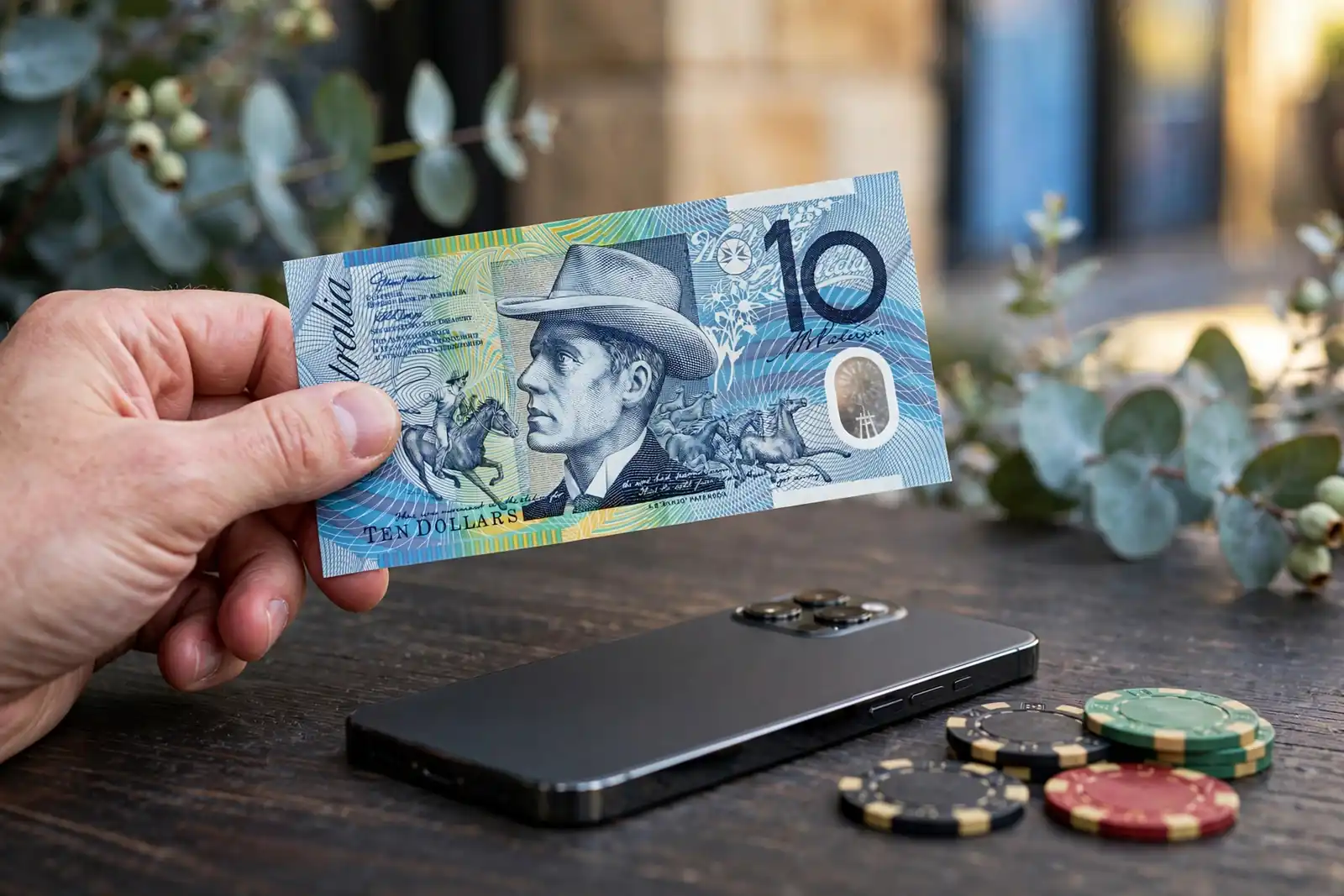
What “$10 Deposit” Actually Means for Online Pokies
A “$10 deposit” can sound like a simple rule: put in ten Australian dollars and you can start. But the figure may describe a payment route’s minimum, not a universal minimum set by the gambling operator. The distinction matters because a deposit passes through more than one set of rules. An operator may not impose a minimum itself, while the payment method or processor handling the transaction can still set a lower boundary.
That is why two pages describing the same service can show different starting amounts. One may quote the operator’s own deposit threshold; another may reflect what a particular payment option will accept. The number you encounter can depend on which part of the transaction the page is talking about. “Low minimum” is only useful wording if it identifies whose minimum it means.
I used to read a headline amount as though it applied to every payment choice. It doesn’t. The operator’s cashier may display several methods, each with its own conditions, and the amount that works for one route may not work for another. A stated $10 minimum is therefore better understood as a threshold attached to a particular arrangement, rather than a blanket promise covering every way of paying.
For a usable deposit, an Australian specialist review described the effective minimum as falling in the $10–$20 AUD range. That is a report from one review, not a fixed rule for every operator or payment method. Still, it helps explain why a search for a ten-dollar starting point often turns up figures above or below that amount: the practical threshold depends on the payment route, not just the headline attached to the casino.
There is another distinction hidden in the word “usable.” A payment can satisfy a stated minimum and still leave you with an amount that feels too small for the intended use. The deposit figure tells you what may be accepted; it does not, on its own, tell you whether the amount will suit the games, spending limit or other conditions involved. Those are separate questions, and the deposit threshold cannot answer them all.

The same applies when you see references to mobile play. Using a phone does not, by itself, establish a different minimum. The amount still depends on the rules attached to the payment method and the operator’s payment process. A “mobile pokies $10 deposit” label may simply be describing a mobile-accessible service with a payment option that accepts that amount. It should not be read as evidence that every method on a mobile site shares the same threshold.
I also learned not to treat the amount shown in promotional wording as the whole story. A headline may make the starting point sound universal, while the payment screen is where the chosen method’s conditions become clear. That does not mean the headline is necessarily false; it may be referring to one route. But without knowing what the figure applies to, it is easy to assume more than it actually says.
For anyone comparing online pokies deposit amounts, the useful question is not merely whether the number is ten dollars. It is whether that number is the operator’s minimum, a payment processor’s minimum, or a figure that applies only to a particular route. Those distinctions are easy to miss when the same short phrase is used for all of them. A low figure can be accurate and still incomplete.
There is an important Australian context here, too: under the Interactive Gambling Act 2001, operators are prohibited from providing real-money online casino games, including pokies, to people physically located in Australia. So these deposit figures should not be taken as an invitation or recommendation to make a payment. They describe how minimums are framed, not whether a service may lawfully be provided to Australian residents.
The practical takeaway is modest. A $10 label may be a payment threshold rather than a casino-wide rule, and a specialist review’s $10–$20 estimate is a reported range, not a guarantee about any particular service. Check what the figure refers to before drawing conclusions from it. The wording matters.
A $10 Minimum Is a Payment Threshold, Not a Promise
A displayed $10 minimum sounds definite: enter that amount and the payment should go through. In practice, it describes a threshold, not a guarantee that every payment route will accept exactly $10. The operator may not set a minimum deposit at all; the payment method or processor can impose one instead.
That distinction is easy to miss. I used to treat the number beside a deposit option as if it were a rule for the whole site. It may apply only to that particular route, or reflect a limit imposed further along the payment chain. Another route can have a different floor. A neat label, then a less neat reality.
The phrase “$10 minimum” can also blur two separate ideas: the smallest amount technically accepted, and the amount that can actually be submitted through a chosen payment method. If the operator’s system can accept a lower figure but the processor sets its own floor at $10, the lower amount is not usable through that route. The operator’s technical setting does not override the processor’s threshold.
So what should you take from a $10 figure? Treat it as a condition attached to a specific payment option, rather than a promise that any deposit of that size will work. The amount shown can be relevant without being universal. It does not, by itself, establish that all payment routes share the same minimum or that the service is available to you.
A specialist review has described the effective minimum for a usable deposit in Australia as falling between $10 and $20 AUD. That is a reported range, not a fixed rule for every operator or payment route. The practical point is narrower: a stated $10 threshold may sit at the lower edge of what a particular route can process, while another route may require more. Don’t turn one displayed amount into a blanket expectation.

There is also a difference between seeing a minimum and having a completed transaction. A payment can be subject to the terms of the method and its processor, so the figure shown beside an option is not the whole story. Before treating it as definitive, read the payment details presented for that route and check what amount they actually permit. If those details conflict with a broad claim elsewhere on the page, the specific payment conditions matter.
I’ve learned not to read “minimum” as “guaranteed starting amount.” It means a lower boundary in a particular context. The context is the important bit.
That matters especially when several payment choices appear together. A page may show a single headline minimum, while individual options have their own thresholds. A $10 figure can therefore be accurate for one route and irrelevant to another. It is not necessarily a contradiction; the figures may describe different parts of the payment process.
Nor should the word “accepted” be confused with “available.” A displayed threshold tells you about the stated payment condition. It does not establish whether a particular service can lawfully be provided to someone in Australia. Those are separate questions.
The cleanest way to read a $10 minimum is as a route-specific payment threshold, not a universal promise about the smallest amount any system will accept. If you are comparing what a page says with what a payment option permits, focus on the terms attached to that option. One number, one route. No more than that.
Do
- Treat the $10 figure as a condition for a specific payment route
- Read the payment details for each specific option
- Focus on the terms attached to the individual route
Don't
- Treat a displayed minimum as a guarantee for all routes
- Assume one headline minimum applies to every payment choice
- Confuse a payment threshold with legal availability in Australia
Which Low-Deposit Methods Come With a Catch?
A $10 deposit can mean different things depending on how the money gets there. The amount shown on a payment screen is not always the amount you can send: a voucher may have a purchase floor, while an e-wallet or crypto transfer can bring fees or network costs into the calculation. I’d check the payment route itself before treating a small figure as usable.
Vouchers: the purchase amount sets the floor
With Neosurf, the voucher purchase threshold can do the deciding. A voucher typically costs at least A$10, so even if a cashier displays a lower deposit figure, you cannot load less than the value of the voucher you bought. In practice, that makes A$10 the effective starting point for this route.
That distinction is easy to miss. The deposit form may look flexible, but you are working with a prepaid amount rather than choosing any value from your bank balance. Check the voucher’s available denominations and whether the cashier accepts that voucher before purchasing it. Otherwise, the money is already committed to a payment method that may not suit the amount you intended to deposit.
Crypto: a tiny minimum can be misleading
Cryptocurrency can show a very low casino-side minimum. A specialist review describes some minimums as low as the equivalent of A$1, and reports that some offshore operators have accepted deposits as low as A$5 AUD through crypto. Those are reported examples, not a dependable promise that a particular cashier will accept either amount.

The casino’s figure is only one part of the transfer. The wallet or network may charge a transaction cost, and the amount you receive can be affected by the transfer process. A small deposit can therefore lose a noticeable share to costs before you even use it. Then there is the game’s own minimum bet: if the balance only covers a handful of permitted bets, the nominally low threshold may not leave much room to play.
I would not read “minimum” as “practical.” Check the current deposit instructions, the required coin and network, and any stated charges before sending anything. A transfer to the wrong network can create a separate problem, so the details matter more than the headline amount. Small number, real friction.
E-wallets: fees and transaction floors
Skrill and Neteller can also have conditions that make a small deposit less straightforward. A specialist review reports that gambling-site deposits through these wallets may carry fees and often have a minimum transaction amount of A$10. The exact charge and threshold can depend on the payment setup, so check both the wallet’s terms and the cashier’s instructions rather than assuming the displayed deposit amount is the whole cost.
Fees matter more when the deposit itself is small. A charge that seems minor in isolation takes a larger bite from A$10 than it would from a larger transfer. If the wallet has its own minimum, that can also override a lower amount displayed by the cashier.
The useful comparison is not just “Which method accepts the least?” It is “How much reaches the account after costs, and can that balance actually be used?” A voucher may lock in a A$10 purchase; crypto may show a lower threshold while adding network costs; an e-wallet may bring fees or its own transaction floor. None of those details is universal, so verify them at the point of payment.
Vouchers
Purchase thresholds, such as A$10 for Neosurf, create an effective starting point regardless of the cashier's displayed figure.
Cryptocurrency
Very low minimums (even A$1–A$5) can be misleading due to wallet transaction costs and network fees.
E-wallets
Services like Skrill and Neteller may impose their own transaction floors (often A$10) and additional fees.
That is the catch with low-deposit options: the number on the cashier screen may describe only one step in the transaction. The payment method can set a higher practical floor, and costs can shrink the amount left to use. A little checking first.
Australian Online Pokies and the Offshore Reality
An Australian theme or “Aussie” label tells you how a site is marketed, not where its operator is based or which authority oversees it. I used to treat the local branding as a reassuring sign. It isn’t proof of Australian regulation. Most online casinos aimed at Australians operate under licences issued offshore, with Curaçao, Malta and the Isle of Man among the jurisdictions commonly named.
That distinction matters more than whether a page mentions an Australian online pokies $10 deposit. A small deposit figure describes a payment threshold; it says nothing about whether the service is lawful here, locally licensed or supervised by an Australian gambling regulator. Nor does an Australian-looking website turn an overseas operator into a domestic one. Separate the sales language from the legal position.
What Australian law says
The main federal law is the Interactive Gambling Act 2001, usually shortened to the IGA. It makes it unlawful for operators to provide real-money online casino-style games to people physically in Australia. That includes pokies as well as services such as online poker, blackjack and roulette. The law is directed at the provision of prohibited services, not at making an individual player’s act of placing a bet with an offshore operator a criminal offence.

That can sound like a contradiction: a service can be prohibited for the operator to provide, while the customer is not criminalised simply for betting with that operator. In practice, it means you should not read “players are not prosecuted” as “the casino is approved here.” Those are different claims. The absence of player liability does not create a local licence or make an offshore gambling service lawful to offer to Australians.
The IGA is the federal framework, and the Australian Communications and Media Authority (ACMA) is the body responsible for enforcing it and monitoring compliance with federal interactive-gambling rules. That is its role in this picture. An offshore licence, meanwhile, is issued by a foreign jurisdiction; it is not an Australian authorisation. I don’t treat a licence badge on a site as a substitute for understanding that difference.
What the licence label does—and doesn’t—tell you
A foreign licence may tell you which overseas authority the operator claims to answer to. It does not mean Australian regulators have licensed that casino to provide real-money pokies here. The same goes for a site that lists Australian dollars, uses local language or promotes a $10 minimum deposit. Those details may make the offer feel familiar, but they do not change the legal status of the service.
I’ve learned not to collapse three separate ideas into one: a site’s branding, its offshore licensing, and its status under Australian law. They answer different questions. A polished “Australian” presentation speaks to its intended audience. A Curaçao, Malta or Isle of Man licence points to an overseas jurisdiction. The IGA sets the federal rules for providing prohibited online casino services to people in Australia.
So, when you see a low-deposit claim attached to an Australian-branded casino, keep the legal context in view. The amount is not evidence of approval, and an offshore licence is not a local one. That’s the distinction.
Real-Money Play: Read the Bonus Terms Before You Deposit
A small deposit can look simple until a promotion is attached to it. “Bonus” sounds like extra room to play; the terms may instead set conditions on when bonus-related winnings can be cashed out. I’ve learned not to treat the headline offer as the whole deal.
Before accepting, check the minimum deposit required to activate the promotion. A page may discuss a $10 deposit, while the bonus has a different entry threshold. If your deposit does not meet that condition, the offer may not apply. Check the wording before confirming anything, not after the balance changes.
Then find the wagering requirement and what it applies to. A specialist review has reported low-deposit bonus requirements in the range of 35x to 50x the bonus amount. That is a source-specific indication, not a universal rule, so the terms for the particular promotion matter. Also check whether the multiplier applies to the bonus alone or to another amount defined in the conditions. The distinction can change how much betting is required before bonus winnings become eligible for a cash out.
The game weighting can make that task longer than the headline suggests. Pokies may count fully toward wagering, while blackjack and roulette may contribute only 10% or 20%. If you choose a game with a lower contribution, your bets may move the requirement forward more slowly. I used to scan for the multiplier and miss the weighting. Easy mistake.
Look for a maximum stake while the requirement is active, too. If the promotion caps a spin at $5 and you exceed that limit, the terms may allow the operator to void winnings. It is not enough to notice the cap: make sure you understand whether it applies per spin and when the restriction ends. A familiar betting habit can become a costly one under a bonus rule.
The practical check is straightforward: confirm the qualifying deposit, the wagering multiplier, and how pokies compare with table games in the contribution rules. Then read the maximum stake condition and any wording about forfeiting winnings. If those rules are hard to find or unclear, don’t assume the most generous interpretation.
A real-money $10 deposit does not make a promotion low-effort, and a bonus balance is not the same as cash ready to collect. The terms decide what can be played, how much must be wagered, and whether a breach affects winnings. Read them first. No guesswork.
What “Best” Means When You’re Depositing Just $10
A stated A$10 minimum can depend on the payment method, so check the deposit terms that apply to your chosen option before you pay. This list gives you the available deposit and licensing details to help you assess the options.
-
House of Pokies
- License
- international iGaming licence – jurisdiction not named in the source
- Payout speed
- PayID 1-24 hours
- Min. deposit
- A$30 (PayID from A$10)
You can deposit from A$10 using PayID, although the stated minimum deposit is A$30. PayID payouts are listed as taking 1–24 hours; the source describes its licence as international but does not name the jurisdiction.
-
7Bit Casino
- License
- Curacao, operated by Dama N.V.
The available detail for you to consider is that 7Bit Casino is licensed in Curacao and operated by Dama N.V. No minimum deposit is specified here.
-
Rollero Casino
- License
- Curacao Gaming Control Board OGL/2023/176/0095 (Hollycorn N.V.)
You can note its listed Curacao Gaming Control Board licence, OGL/2023/176/0095, and operator, Hollycorn N.V. No minimum deposit is specified here.
-
LevelUp Casino
- License
- Curacao eGaming OGL/2023/174/0082 (Dama N.V.)
- Min. deposit
- A$15
LevelUp Casino lists a minimum deposit of A$15, so it is not a stated A$10-minimum option. Its listed licence is Curacao eGaming OGL/2023/174/0082, with Dama N.V. as operator.
-
Golden Pokies
- License
- Curacao
The available detail for you to consider is its Curacao licence. No minimum deposit or other operator details are specified here.
-
WinSpirit Casino
- License
- Curacao eGaming OGL/2024/923/0383 (Antillephone N.V.)
- Min. deposit
- A$30
WinSpirit Casino lists a minimum deposit of A$30, rather than A$10. Its listed licence is Curacao eGaming OGL/2024/923/0383, held by Antillephone N.V.
-
Vegaz Casino
- License
- Curacao OGL/2024/1335/0780
- Min. deposit
- EUR 20
Vegaz Casino lists a minimum deposit of EUR 20, not A$10. Its licence is listed as Curacao OGL/2024/1335/0780.
-
Playfina Casino
- License
- Curacao eGaming (Hollycorn N.V., since 2017)
- Min. deposit
- A$20-30 (depends on the offer)
Playfina Casino's stated minimum deposit is A$20–30, depending on the offer. It is listed as licensed by Curacao eGaming, with Hollycorn N.V. as operator since 2017.
-
Uptown Pokies
- License
- Curacao (operating since 2017)
- Min. deposit
- A$20
Uptown Pokies lists a minimum deposit of A$20 and is described as operating since 2017. Its licence is listed as Curacao.
-
Wild Tokyo
- License
- Curacao
- Payout speed
- crypto 30-60 minutes, fiat 1-5 days
- Min. deposit
- A$10
Wild Tokyo lists a minimum deposit of A$10. Its stated payout speeds are 30–60 minutes for crypto and 1–5 days for fiat; it is licensed in Curacao.
I’d be wary of calling any real-money online casino option “best” for someone in Australia. The Interactive Gambling Act prohibits operators from providing online casino games to people here, so a foreign licence does not make the service a locally licensed option. The useful question is not which offer sounds most attractive, but what its terms would mean for your money—and whether using the service is appropriate at all.
A $10 deposit is not the same thing as $10 you can later cash out. If you play with deposited funds, the balance can change as you play. If you accept a promotion, the bonus may come with separate conditions that restrict when winnings can be cashed out. I’d treat “bonus” as “extra funds with strings attached,” not as money already in your account.
The arithmetic can be sobering. A specialist review gives the example of a $1,000 bonus with a 35× wagering requirement: that calls for $35,000 in total bets before bonus winnings become eligible for cashout. That illustration is not a claim about every promotion, and a small deposit does not make a wagering requirement disappear. Read whether the multiplier applies to the bonus or another amount, and check the maximum cashout cap before accepting anything.
- Confirm the qualifying minimum deposit for the promotion
- Identify the wagering multiplier (e.g., 35x to 50x)
- Check the game weighting for pokies versus table games
- Verify the maximum stake allowed while wagering
- Review the maximum cashout cap
Then look at the rules while wagering. The maximum permitted bet matters: exceed it and winnings may be voided under the promotion’s terms. Game weighting matters too. Pokies may count fully toward wagering, while table games can contribute far less, so switching games may slow progress rather than help. “Flexible” can be a very narrow word.
Finally, check the cashout threshold. A specialist review described minimum cashout amounts in the $20–$50 AUD range; that is a reported range, not a fixed rule, and terms can change. If the balance is below the applicable minimum, it may not yet be eligible for a cashout. A headline $10 starting point tells you nothing by itself about the amount you could ultimately receive.
For me, the sensible test is plain: understand the legal context, read the promotion and cashout terms in full, and don’t count bonus funds as withdrawable money. If the conditions are hard to find or hard to explain, I wouldn’t treat the offer as a bargain. A small number on the deposit button is not the whole deal.
The Smallest Deposit Isn’t Always the Most Usable
A listed minimum tells you what may be accepted at the cashier, not how much will make a workable balance. I learnt that the annoying way: I treated the smallest figure on a payment screen as a sensible starting point, then found that fees and the cost of placing bets could eat into it before I had much room to play.
A specialist review reported that some casinos set a cryptocurrency deposit minimum as low as the equivalent of A$1. That is a nominal threshold, not evidence that a dollar will go far. A transaction cost can take a meaningful bite out of a very small transfer, and a game’s minimum bet can leave little flexibility once the funds arrive. The number looks tiny. The usable balance may be tinier.
For a more realistic comparison, a specialist review placed the most common effective minimum for a usable Australian deposit in the A$10–A$20 range. That is a report from one review, not a fixed rule across the market; the amount can depend on the cashier and payment route. Still, it helps explain why searches for pokies with a A$10 minimum deposit often lead to a practical question: not just whether the deposit can be made, but whether enough remains to use it.
Then there is the other end of the transaction. A specialist review reported that minimum cash-out amounts are often A$20–A$50. That can matter if you start with A$10: a small balance may not meet the stated cash-out threshold, even if you would rather stop. Check that condition before putting money in. It changes what “small deposit” means in practice.
I now separate three figures in my head: the amount shown as the deposit minimum, what may be lost to transaction costs, and the threshold for cashing out. They are not interchangeable. A tiny deposit can be technically accepted but awkward to use; a somewhat larger one may leave more room after costs and bets. No magic number. Just arithmetic.
That distinction matters whether you type “A$10 minimum deposit pokies” into a cashier search or see a low figure in a promotion. The deposit amount alone cannot tell you whether the balance will be practical, or whether you can cash out a small remainder. Read the cashier’s terms and the cash-out rules before deciding. I used to look only at the first number. That was the mistake.
PayID, Bank Transfers and the $10–$20 Starting Point
A PayID option can look like a straightforward way to make a $10 AUD deposit, but the amount accepted depends on the payment setup shown at the point of transfer. A specialist review places the typical minimum for PayID or instant bank transfer in the AU$10–AU$20 range. Treat that as a reported guide, not a fixed rule: a displayed minimum can change, and the payment screen is what tells you whether a particular amount will go through.
I’d check the minimum before entering any banking details. If the stated threshold is higher than the amount you intend to send, trying anyway may simply leave you with a failed transaction or a delay while you work out what happened. Keep the amount and recipient details exactly as instructed by the payment page. Don’t assume that a transfer initiated from your bank means the receiving service has credited it.
Instant bank transfers and ordinary bank transfers are not interchangeable in practice. A standard bank transfer can take several business days to process, and the sending bank may charge a fee. That makes it a poor fit when you are trying to move a small amount promptly: a delay or fee can matter more when the deposit itself is modest. PayID is the bank-based option to check when timing matters, but the word “instant” should not be read as a promise about every stage of a transaction.
Cash-outs have their own timing. A specialist review identifies PayID among the faster reported cash-out methods, with some payouts described as arriving the same day. That is not a guarantee: account verification, the operator’s processing, and the receiving bank can all affect when funds appear. A quick transfer method does not necessarily mean the whole cash-out process is immediate.
There is a legal point worth keeping in view: offering real-money online casino games to people in Australia is prohibited under the Interactive Gambling Act 2001. Payment information does not change that. I would not treat a PayID logo or a low deposit threshold as evidence that an online casino service is lawful or protected locally.
Is PayID a guaranteed instant deposit?
While it is a bank-based option for speed, "instant" should not be read as a promise for every stage of the transaction.
What is the typical minimum for PayID transfers?
A specialist review places the typical minimum for PayID or instant bank transfers in the AU$10–AU$20 range.
How fast are PayID cash-outs?
Some are reported as arriving the same day, though verification and processing can still affect the timing.
For a bank-based transfer, the useful checks are simple: confirm the minimum shown on the payment screen, look for any sending-bank fee, and allow for the possibility that a transfer will not be credited straight away. A low number on a page is only one part of the transaction. A delay still counts.
Australian Players: Check the Rules and Access Risks
A low deposit does not make an online casino legal to use in Australia. The Interactive Gambling Act 2001 prohibits operators from providing real-money online casino games to people in Australia. That includes pokies and other casino-style games. The law targets the service provider; an individual player is not criminalised simply for placing a bet with an offshore operator.
The Australian Communications and Media Authority (ACMA) enforces the Act and monitors compliance with federal interactive gambling rules. Its role has practical consequences: when a service is considered prohibited, ACMA can ask Australian internet providers to block access to the website. A page that worked yesterday may therefore become unavailable. That does not necessarily mean the operator has closed; access from Australia may have been restricted.
The scale is not small. Following enforcement action, ACMA says it has blocked more than 1,455 illegal gambling and affiliate websites since November 2019. Those figures cover both gambling services and affiliate sites, so a blocked address does not tell you, on its own, exactly what happened to the business behind it.
There is also a discrepancy in reported market withdrawals. One figure puts the number of illegal services that left Australia since ACMA began enforcing the rules in 2017 at more than 210; another reports over 190. The counts differ, so it would be misleading to present either as a settled total.
For anyone comparing Australian pokies with a $10 deposit, the practical point is that a payment threshold says nothing about whether the service is permitted or whether its website will remain reachable. A blocked site can interrupt access regardless of the amount deposited. I’ve learned not to treat a familiar-looking Australian label, or a page that loads today, as proof of legal status or lasting availability.

Check the regulatory context before making a decision, and don’t mistake a site’s own claims for an ACMA finding. A small deposit is still money at risk if access changes or a service leaves the market. No deposit removes that uncertainty.
When a $10 Minimum Is the Lowest Practical Option
A $10 minimum can be a sensible limit to look for, but “lowest” on a payment screen does not necessarily mean you can do much with that balance. I’ve learned not to treat the smallest advertised figure as the price of a usable session.
A specialist review has reported offshore operators accepting deposits of $5 AUD through cryptocurrency. The same kind of review has described casino-set crypto thresholds as low as the equivalent of $1 AUD. Those are reported examples, not a dependable standard. The amount shown at the deposit stage may also leave out the cost of moving cryptocurrency, while a game’s minimum bet can make a tiny balance disappear before it offers much play.

That is the practical test: after any transaction costs, does the amount left still make sense for the game’s minimum stake? If not, the nominal threshold is mostly a headline. A $10 deposit may be more usable, but it is not automatically good value either; the answer depends on the costs and rules attached to the payment route and game.
There is also a legal point that matters more than the deposit figure. Australian law prohibits operators from providing real-money online casino games, including pokies, to people in Australia. A low advertised minimum does not change that position, and this is not a recommendation to use an offshore service.
I’d read “lowest minimum” as a claim about what a payment route may accept, not proof that the amount is practical or that the service is lawful for Australian residents. Check the transaction cost and game minimum before treating any figure as usable. Small number. Not the whole cost.
What is the actual minimum deposit at a no-minimum-deposit casino in Australia?
There may be no minimum set by the operator, but the payment method can set one. A usable deposit commonly starts at AU$10–AU$20; some offshore operators accept as little as AU$5 via cryptocurrency.
Are no-minimum-deposit casinos legal in Australia?
The Interactive Gambling Act 2001 prohibits operators from providing real-money online casino games, including pokies, to people in Australia. The Act does not criminalize an individual for placing a bet with an offshore operator.
What is the minimum deposit and what are the wagering requirements?
A usable deposit commonly starts at AU$10–AU$20, though the payment method may set a different minimum. Low-deposit bonuses may require wagering of 35× to 50× the bonus amount before winnings can be withdrawn.
Can I withdraw winnings from a low deposit?
Yes, if you meet the casino’s withdrawal conditions and minimum withdrawal amount, which is typically AU$20–AU$50. Bonus wagering requirements may also need to be met before bonus winnings can be withdrawn.
Do low-deposit bonuses have wagering requirements?
Yes. They may require wagering of 35× to 50× the bonus amount; slots typically count fully, while blackjack and roulette may count only 10% or 20%.
What is the fastest way to withdraw at an Aussie online casino?
PayID and cryptocurrency are among the fastest methods: PayID withdrawals are often same-day, while USDT on TRC-20 can clear in minutes after account verification.